March 02, 2026
The (virtual) reality of "Madama Butterfly"
Transforming Puccini’s opera into a game-world has somehow made it more real
Puccini’s opera Madama Butterfly was always a kind of fantasy, a tale centered on a young Japanese woman that was created by older white men who had never set foot in her country. The century-old masterpiece tells the story of the title character, who falls in love with an American officer, Pinkerton, who cruelly abandons her. Yet its tragic quality and gorgeous music have rightly made the work an enduring favorite.
The whole thing is, as they say, problematic.
Matthew Ozawa, a Japanese American director, and Chief Artistic Officer at Lyric Opera of Chicago, collaborated with a team of Japanese and Japanese American female artists to create a new space for the work, a space where women in particular could see something of their real lives. It’s a powerful paradox to discover that the collaborators’ brilliant solution was to turn the entire experience into a game. The work comes to life in its first moments when Pinkerton dons a set of VR goggles. Instead of limiting his vision, entering the virtual world expands it — and this production takes us along. The music becomes a kind of gorgeous soundtrack to the action onstage.
Gaming and opera: not so different, after all.
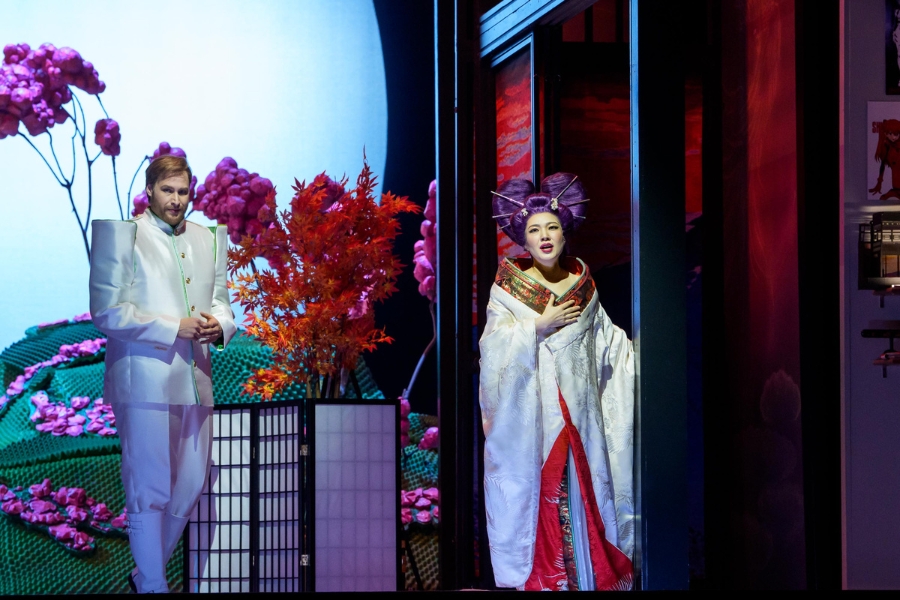
Pinkerton and Butterfly share a romantic moment within a technicolor landscape.
The marriage of a 400-year-old artform with 21st-century gaming seems unlikely at first, but the parallels run deep. Both rely on grand-scale, multi-sensory world-building to draw their audiences into an immersive storytelling experience. Opera is the live intersection of all of the performing arts: orchestral and vocal music, theater, and stagecraft. Game developers and opera directors alike seek to bring their audiences into a transformed world, where nearly anything is possible.
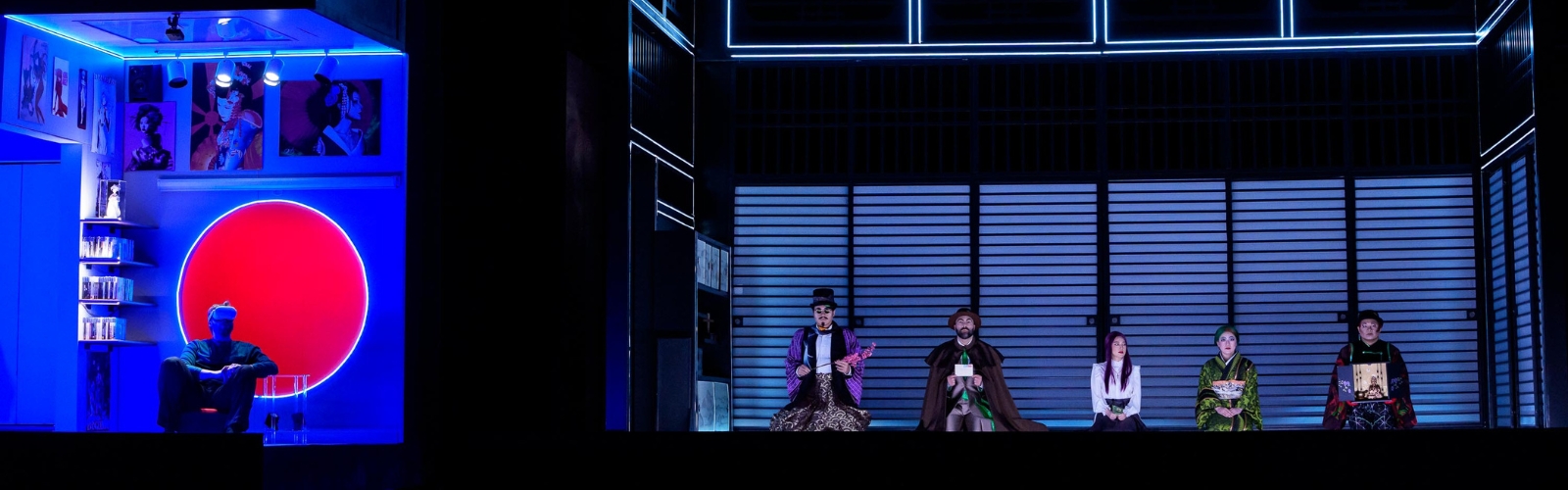
In Lyric’s production of Madama Butterfly — as in real world gaming today — the shift from Pinkerton’s present-day apartment into the “game” of Butterfly occurs in an instant. It’s a bit unsettling, and certainly thrilling — a sensation familiar to devoted gamers. Through set design, costuming, and lighting as vivid as any online environment, Ozawa’s team transports the audience to the larger-than-life drama and heightened emotions of Butterfly’s world.
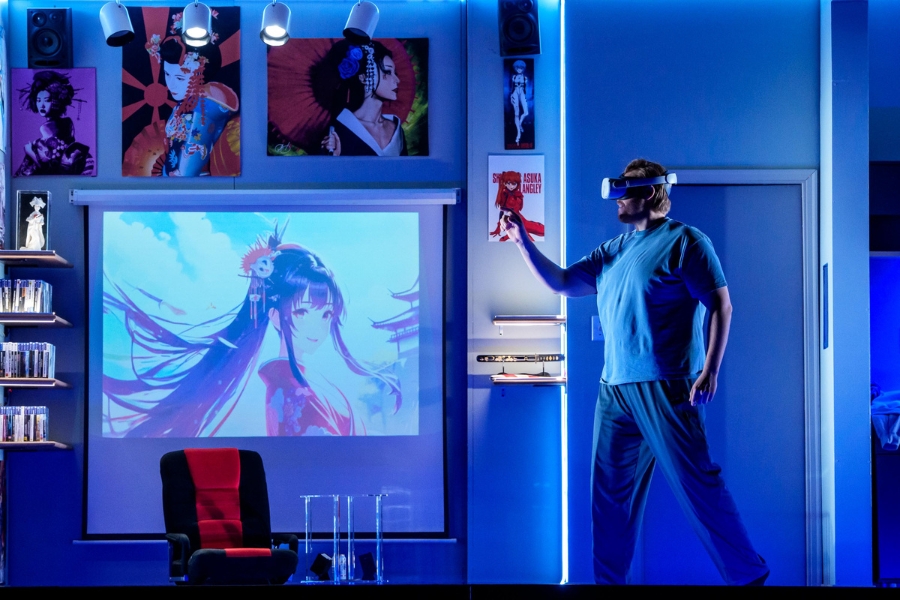
Lt. B.F. Pinkerton uses a virtual reality headset to step into the world of "Madama Butterfly."
Classical music of many kinds has been part of gaming almost from the start, and during the surge of growth in the 1980s, immortal composers were brought along. Mozart’s Eine kleine Nachtmusik is inextricable from Nintendo’s Mario Bros. J.S. Bach’s music accompanied 1982’ Donkey Kong Jr. and provided the hypnotic soundtrack to the 1989 edition of Tetris.
Over the last three years, acclaimed soundtracks span blockbuster RPGs (Final Fantasy XVI, Zelda: Tears of the Kingdom), narrative-driven experiences (Alan Wake 2), beloved franchise reinventions (Final Fantasy VII Rebirth), and critically celebrated newcomers (Claire Obscur: Expedition 33), with recognition from both fans and major award bodies.
The depth and complexity of video game scores has only deepened over the decades, and much like great operas — and great movies — music is used to enhance the narrative, establish atmosphere, and deepen the suspense or impact of thrilling moments. The industry has used classical music so effectively that it’s often seen as an exciting new entry point to classical music for many younger audiences.
The first Grammy Award for Best Score Soundtrack for Video Games and Other Interactive Media was presented in 2023. This year’s winner was composer Austin Wintory, for Sword of the Sea — beating out fellow nominees Avatar: Frontiers of Pandora - Secrets of the Spires (Pinar Toprak), Helldivers 2 (Wilbert Roget II), Indiana Jones and the Great Circle (Gordy Haab), and Star Wars Outlaws: Wild Card & A Pirate's Fortune (Cody Matthew Johnson & Wilbert Roget II). The establishment has finally caught up with what working composers (and gaming enthusiasts) had known for years: original, exciting music is a crucial part of the gaming experience.
“That kind of scoring is a huge part of the industry,” says composer Tony Scott-Green, chair of the Chicago chapter of the Society of Composers and Lyricists, an organization whose membership has included Erich Wolfgang Korngold, Bernard Herrmann, Henry Mancini, Quincy Jones, and John Williams, among other titans. “Those composers tend to specialize, but lots of crossover happens. It’s all musical storytelling — exactly like opera.”
The fanbases for opera and gaming have remarkable similarities — deeply passionate and engaged communities of followers who wait with anticipation for new releases, collect memorabilia, and love to connect with their fellow fans. Listening to discussions on peak experiences in online forums or sharing strong opinions about works, storylines, and artists over dinner, you might be hard-pressed to distinguish between conversations about a new game release or a new opera production. The deep engagement and personal connection that brings people together is just one of the many things people love about both genres.
The New Yorker magazine described the Butterfly production about to arrive at Lyric as “vibrantly colored,” and that may be an understatement. In bringing the opera into the present-day world of immersive video games, the all-female Japanese design team — with sets by Kimie Nishikawa of dots design collective, costumes by Maiko Matsushima, and lighting by Yuki Nakasi Link — has created an original, hypnotic world. It is, one critic wrote, an “ingenious… heightened, and fantastical Butterfly that pulses with life — while bringing new perspective to the story.”
That’s just what they set out to do. “Our team’s goal was to reclaim the opera’s narrative,” Ozawa says. “May the voyage into this production's fantasy capture your senses, sweep you up in the music's emotional power, and awaken your own lens.”
You know that moment in a game when you realize the choice you made can’t be reversed? That’s this story.