May 20, 2026
Direct report: Matthew Ozawa on 20 years at Lyric
For Matthew Ozawa, Chief Artistic Officer, the 2026/27 Season at Lyric Opera of Chicago will mark 20 years with the company — and 10 seasons since his mainstage directorial debut. To commemorate these milestones during AAPI month, we spoke with the busy artist about his body of work, the primacy of the score, and what the future holds for the art form.
What were you doing when you first arrived at Lyric in 2007?
I started in Stage Management & Direction, becoming the most senior assistant director my second season with the company. My first show at Lyric was as an assistant stage manager on Puccini's La Bohème, directed by the legendary singer Renata Scotto. I also worked on Strauss' Die Frau ohne Schatten and Adam's Doctor Atomic with Peter Sellars. I was assigned to two of the season’s most demanding musical projects because for some of the moments in the show, I was the only one backstage who could read the music.
Had you been in the house before?
In 2004 I was studying clarinet at Oberlin Conservatory, and my musicology class made a field trip to Lyric to see Blitzstein's Regina. The entire experience was awe inspiring and grand. We sat in the last row of the top balcony — a spot known for the glorious sound of the music. During intermission, some patrons who didn't want to stay for the second half came up to the top floor and gave me and a friend their tickets. So for the second half of the opera, we sat in the orchestra level, and I was completely mesmerized by the scale of the production and the beauty of the Art Deco opera house. I never would have imagined that I would land here in stage management and direction, let alone as a mainstage stage director or as Lyric’s first Chief Artistic Officer. And a little insider secret, my spouse actually proposed to me in the Rice Grand Foyer during the pandemic. As a result, this theater and this company hold a very special place in my life.
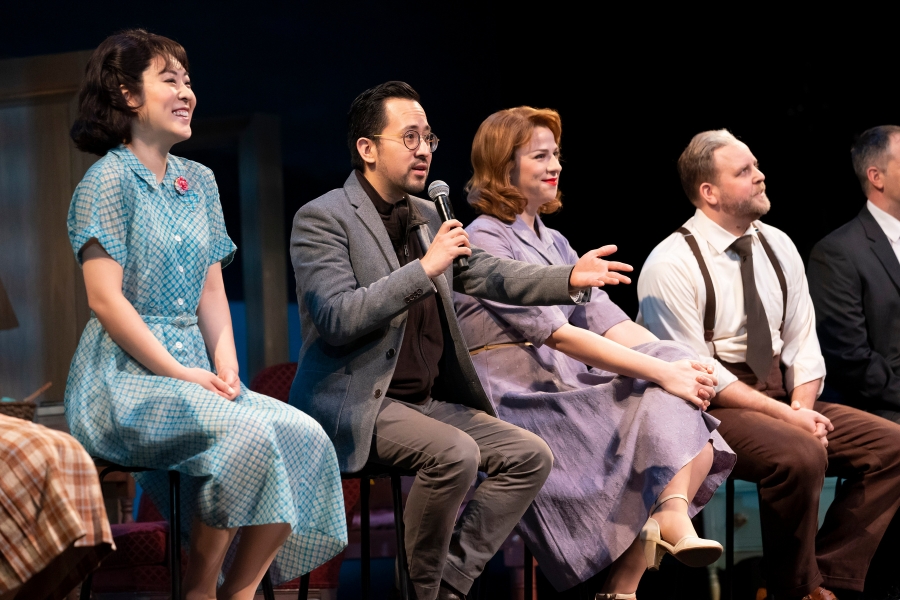
Matthew Ozawa participates in an audience talkback with the cast of An American Dream in Lyric's 2018/19 Season.
There’s another mile-marker here as well. It’s been a decade since you first directed on Lyric’s mainstage.
Correct! I made my mainstage directing debut with Nabucco in the 2015/16 Season. The next season I directed Massenet’s Don Quichotte, so both those works hold a very special place amongst my artistic work.
2016 seems like a momentous year for you. You created a Romeo and Juliet that has proven very successful.
Correct, I directed a new Romeo and Juliet for Minnesota Opera, and this coming season it will be revived for the ninth time! It has been seen all over the country. In addition, in 2016 I also presented work at Carnegie Hall and the Kennedy Center with the Grammy Award-winning Chicago ensemble, Eighth Blackbird.
What do you think has made it so popular?
I created the production at a time where I was known as the Project Runway director. I was an expert at ‘making it work,’ creating beautiful grand productions under unusual circumstances. A company would present a series of challenging and sometimes limiting design and time parameters, and I’d take what existed and create something entirely new. Because I couldn’t work with designers I knew on designs from scratch, I would reduce a piece down to its core thematic essentials, and then composite together various existing items to amplify those focused ideas. The core, though slightly reductive, essential for Romeo and Juliet is that it is about love, it is about hate, and it is about that sort of triangulation where love and hate meet in the middle resulting in death. So for my Project Runway approach, I ‘shopped’ in their warehouses, and pulled roses to symbolize ‘love’ and swords to symbolize ‘hate.’ Then I amplified these images, creating scenes with huge floating roses during scenes about ‘love’ and a ceiling of hanging swords during the scenes involving ‘hate.’ Romeo and Juliet’s love lives in a dreamlike state, as does Gounod’s music, so ironically, the simplified reduction ended up creating a glorious and lush landscape that has kept audiences captivated and moved for over a decade! In some respects, bold visual gestures have become a hallmark of my work, and I attribute that sensibility to my early days creating U. S. productions.
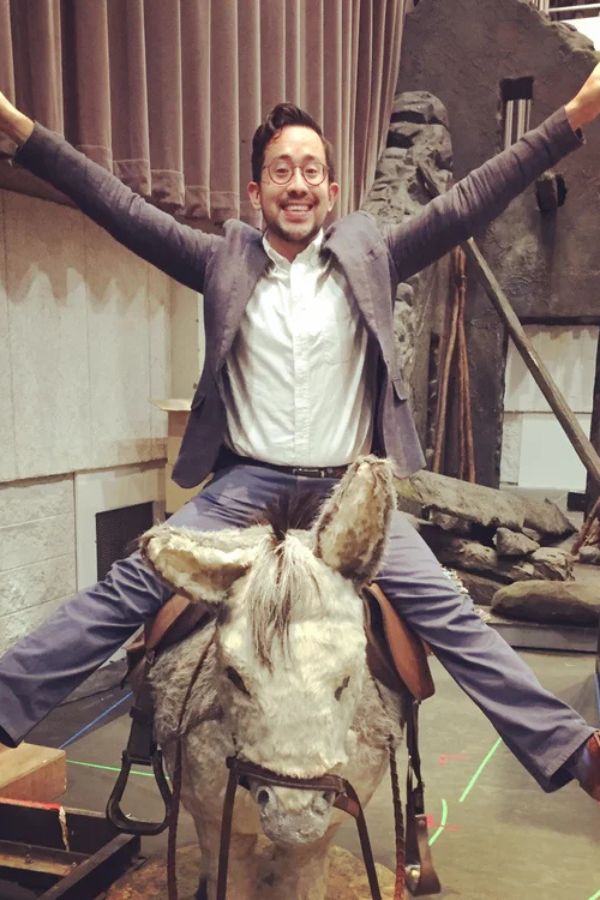
Ozawa having fun backstage at Lyric during rehearsals for Don Quichotte in 2017.
How have you evolved over the ensuing decade?
My later work is maybe a little more specific in its messaging, more specific in the contemporary framing that I investigate works with, like on Beethoven’s Fidelio (2024/25) and Puccini’s Madama Butterfly (2025/26) at Lyric. While all of my work balances an East / West aesthetic as well as balancing minimalism with spectacle, my later work found me wanting to see the narratives through our current zeitgeists.
Where does your recent Parsifal at San Francisco fit in?
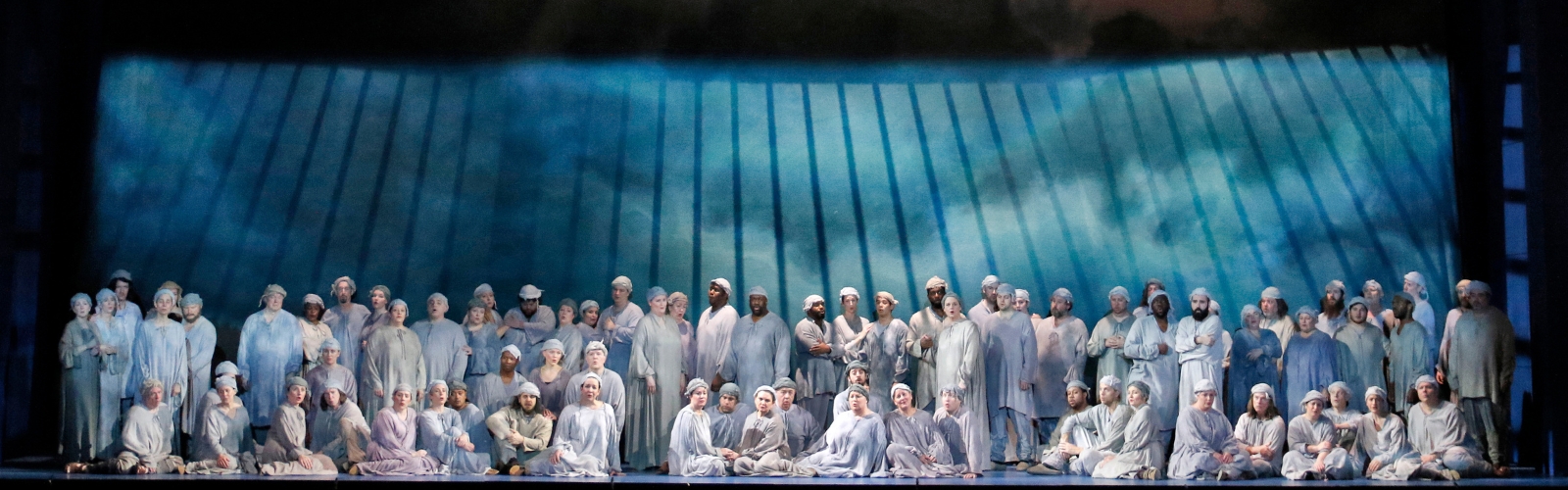
Wagner’s Parsifal is the Holy Grail of opera, literally — one of the most difficult pieces in the canon to produce, and for audiences to experience. It is a five-hour long opera that requires a level of meditative patience and presence to tap into something spiritual. Wagner created his own kind of new religion by synthesizing Christian symbols with Buddhist philosophy. While most productions focus on the Christian aspects of the narrative, Wagner was influenced by Schopenhauer and Buddhist thought, and these Eastern elements deeply permeate the work. As a result, being mixed race, displaying an East / West fusion felt like an ideal choice for my fourth new production at San Francisco Opera. While most of my work displays cultural fusions, directing Parsifal enabled me to really delve into Eastern aesthetics: Noh theater, Butoh dance, Asian armor and clothing. The creative team and I then fused these elements with Christian and Western religious practices to create entirely new environments that would feel both comfortable and yet foreign to audiences, and deepen Parsifal’s journey over the five hours.
This seems like a signature move for you, to illuminate something that resides in the opera already.
My work tends to sit outside of a traditional Western lens because my creative practice is influenced by Eastern aesthetics and philosophies and practices. My art can feel different to audiences, and can require repeat viewings to be awakened to its nuances. But what I aim to do consistently, because I love music and I love opera, is to honor the story, honor the history, and cultivate in visual and movement form the story as it’s revealed through the score and the music. I start with the score and music first and foremost. I have a degree in musicology and music theory. I analyze the score. I sit with the music. I let visual images permeate my thoughts as I'm listening. And that time with the music reveals certain truths, my truths, about how to intersect some of these works. For Parsifal, audiences have always felt comfortable with its connection to the Arthurian myth and Christianity symbology. As a result, the Buddhist philosophy that permeates the piece has been put on the back burner for most folks. So my production, yes, does bring to the fore things that were already inherently there.
Ozawa directs a grippingly modern production of Beethoven's Fidelio in Lyric's 2024/25 Season.
Your approach to Madama Butterfly gave audiences a very new experience.
There's an immense amount of dramaturgical research permeating my choices. I usually give cast members an hour-long lecture for each show I direct, but I never expect audiences to be walking in with that knowledge. Rather, I acknowledge that audiences come to the theater with their own frame of reference, their own biases, their own prejudices. The beauty of art is that it can be seen by so many people with differing viewpoints! For opera’s most famous works, there are a lot of expectations on directors to portray the work in a traditional manner, usually built on the sense memory people have from having seen the work numerous times throughout their lives. As artists, we are creating something that's living and breathing, something audiences experience in real time. How audiences view a work in one moment is never going to be the same as another moment, and how one person experiences it will not be identical to how another views it.
Are you speaking about a specific time, or a specific place?
What is happening inside the theater cannot be divorced from what is happening outside the theater. They exist simultaneously. As much as audiences want to be entertained and they want to escape, ultimately everything that they're experiencing and processing in their ‘outside’ life comes into the experiencing of the art ‘inside’ the theater. For me, art is meant to be experiential. It's meant to provoke. Things are not meant to be the same for all. What's so beautiful about being a director is taking a piece and conceiving it in a specific way, and then seeing that remounted in different cities and evolving over time. Butterfly is a good example. When we created it, no one owned VR goggles. AI did not exist. Now all of that has completely infiltrated society and is becoming a mainstay of many people's work environments and forms of relationship-building and new realities.
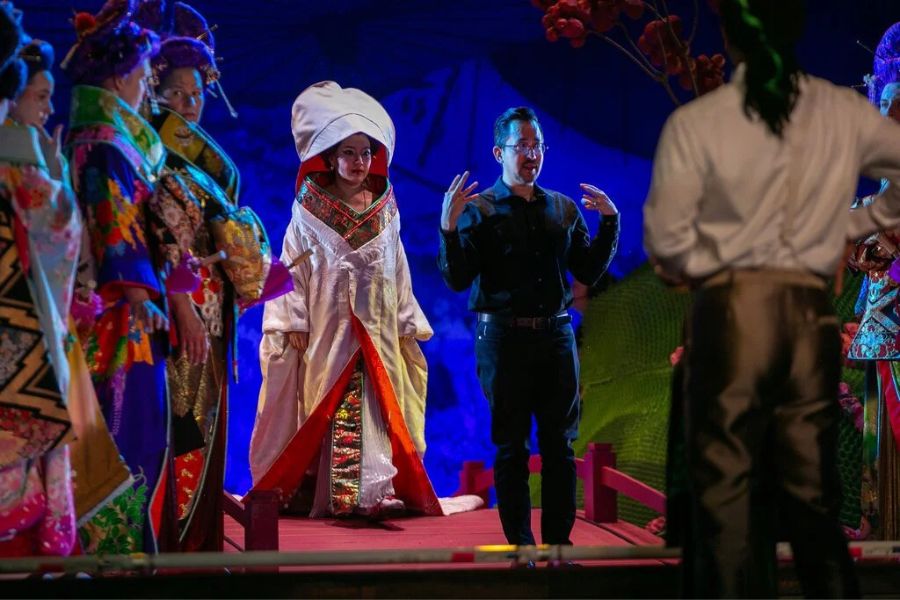
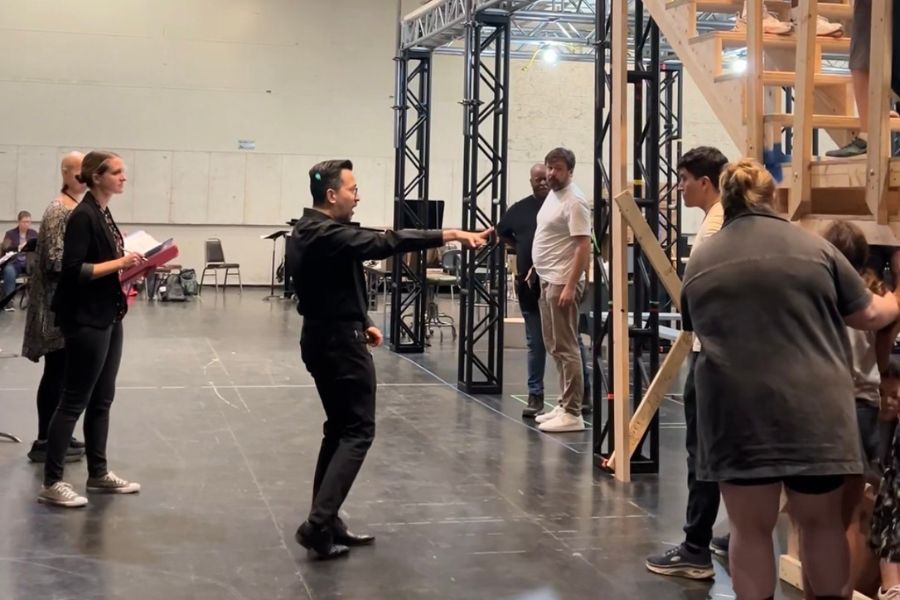
Director Matthew Ozawa in rehearsals for Madama Butterfly at Lyric in 2026.
The reframing of works, one of your signatures — is this a path forward for the art form?
I believe so. Because live performing arts are not an actual museum; these pieces have to be seen through new lenses. I totally understand railing against the director being at the top of the food chain and putting anything and everything on the stage and being provocative for provocation’s sake. But there's beautifully done work that combines forms of architecture and other art forms within the mix of the live performing arts. I embrace tradition while simultaneously allowing new audiences a chance to experience the music and story through their unique contemporary lenses. So for those that love the tradition, this can indeed feel like a very new surprising experience.
You have so much passion for the work itself. How do you blend that with your significant administrative duties?
I think every experience feeds into the work of making art, into our practice. Because I’m an artist who has worked across disciplines and in various artistic roles, I understand what is needed to ‘make’ the art at the grandest scale, and the impact choices on the administrative side can have on the process. As a result, my goal is to serve the art, the artist, and be a shepherd towards artistic processes that can result in the continued excellence of each production and project at Lyric. It’s a joy each day to provide the foundation for each singer, artist, instrumentalist, technician, and craftsman to let their artistry sing.