October 05, 2026
Director's note: Kaneza Schaal on "Omar"
The opera we share with you here touches the bones of our country. Whether we are the first generation in our family to sleep on this soil, whether our family has been sleeping on this soil for many generations, or whether this soil birthed our ancestors, this story has built all of our lives. The story of Omar Ibn Said — a Fulani man, forced to the United States and enslaved, literate before being stolen from his home in West Africa, and author of an autobiography.
Slavery, of course, existed before people were torn from their homes in West Africa at gunpoint and enslaved in the United States. The institution of American Chattel Slavery wrought a unique new violence, as an institution of language. American Slavery created and named a permanent condition attached to your body.
The ferocious clarity in American Slavery on the power of language was such that one of the most sacrosanct laws was that you could not teach enslaved people to read. Or write.
And here, we have a text! From Omar Ibn Said. Written by Omar. An Islamic scholar. His autobiography is the prayer from which the music and words you hear tonight were created. The glory and triumph that his words exist, even if generated under duress, is holy.
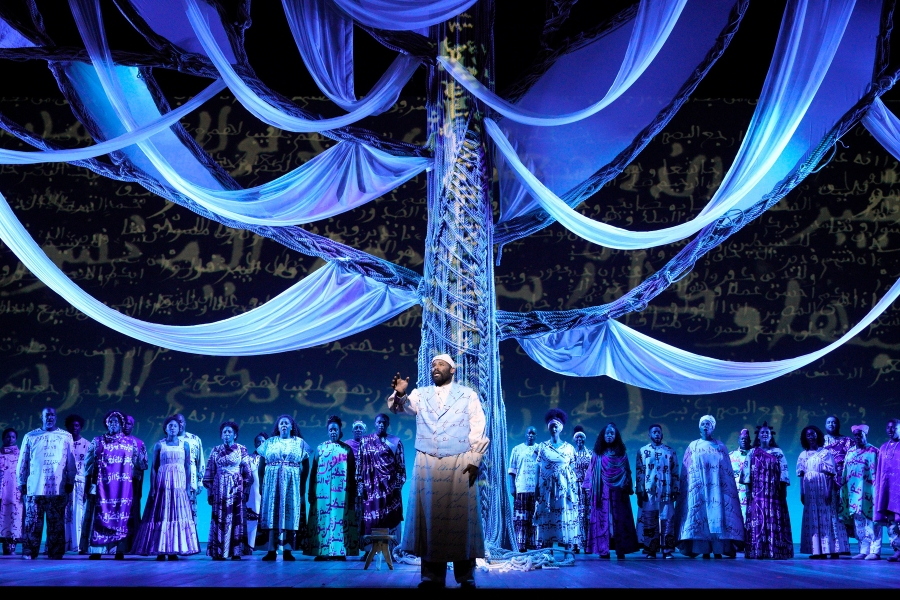
LA Opera's 2022 production of Rhiannon Giddens and Michael Abels's Omar.
We gather to tell you Said’s story through the contest of languages in his life — spiritual languages, cultural languages, spoken and written languages, the language of materials like wood and fabric. And ultimately, Said’s holding of all of these languages simultaneously brims with resistance, omission, refusal, and reincarnation.
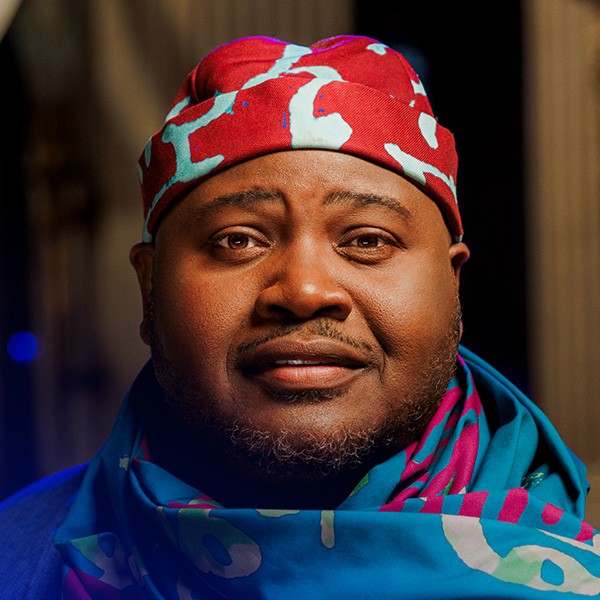
We gather around Issachah Savage, who will transform himself into Omar, joined by a company of players to support him, as the mighty bard, in singing you this tale. All of the players follow Savage in donning fabrics printed with Omar’s writing, as well as texts from the language of American Chattel Slavery, runaway woodcuts, ship manifests with the names of kidnapped persons, ledgers with the sale of families.
We gather dressed in indigo. Along with the stolen humans and their labor came science and technology the American colonists had never known. One example is the ornate process of growing, harvesting, and creating indigo dye, a new knowledge brought by Africans to the Americas, which became a fixation of colonial activity. Mercenaries were sent to West Africa to kidnap and import scientists to expand this industry. Indigo was the second-largest export from South Carolina during Omar’s life.
After the American Revolution (when this precious dye was no longer being sent back to Europe), indigo as a crop was surpassed by cotton. Together, these two brutal crops, tended by forced labor, led to the rise and life of American Blue Jeans.
An opera house is perhaps one of the few places big enough for Said’s journey — the contradiction, the violence, the holiness, the omissions, the terror and the triumph.
Listening to the story of Omar Ibn Said tonight, together, let us begin resetting the bones.