October 22, 2026
No Longer Hidden: Omar ibn Said’s American Story
In a commemorative year crowded with national self-narration, Rhiannon Giddens’s and Michael Abels’s Omar asks a sharper question: What is the country actually invested in remembering?
The rituals of national anniversaries can bind a country together, yet they can also reveal a collective habit of selective, curated memory. From the recesses of history, Rhiannon Giddens’s and Michael Abels’s Omar brings forward the life of Omar ibn Said, a West African Muslim scholar who was captured, stolen across the Atlantic, and enslaved in the American South, and who wrote his autobiography in Arabic while still captive in North Carolina. His story unsettles any anniversary language that treats America as a completed moral experiment. It reveals the country as promise and contradiction, aspiration and violence, self-invention and erasure.
To encounter Omar in this commemorative year, then, is to ask whether national memory can bear the weight — and hear the voices — of the people it has too often made peripheral. Where current political rhetoric puts pressure on institutions committed to recovering suppressed histories, Omar replies with evidence. It deepens our archive of American history, complicates the mythology of a single, unified national voice, and restores attention to a man whom enslavement sought to suppress and contain.
Omar asks for a demanding ear. It envoices a scholar whose archive lives partly in Arabic script and Qur’anic memory, and whose afterlife passes through slavery’s ledgers, missionary accounts, and mistranslation. Its commanding overture centers around the “Koromanti” melodies of 17th-century Jamaica, building upon what is believed to be the earliest example of musical expression by enslaved persons in the New World. It asks the nation to love itself through unyielding truth, and with enough moral stamina to hold beauty and brutality in the same field of vision.
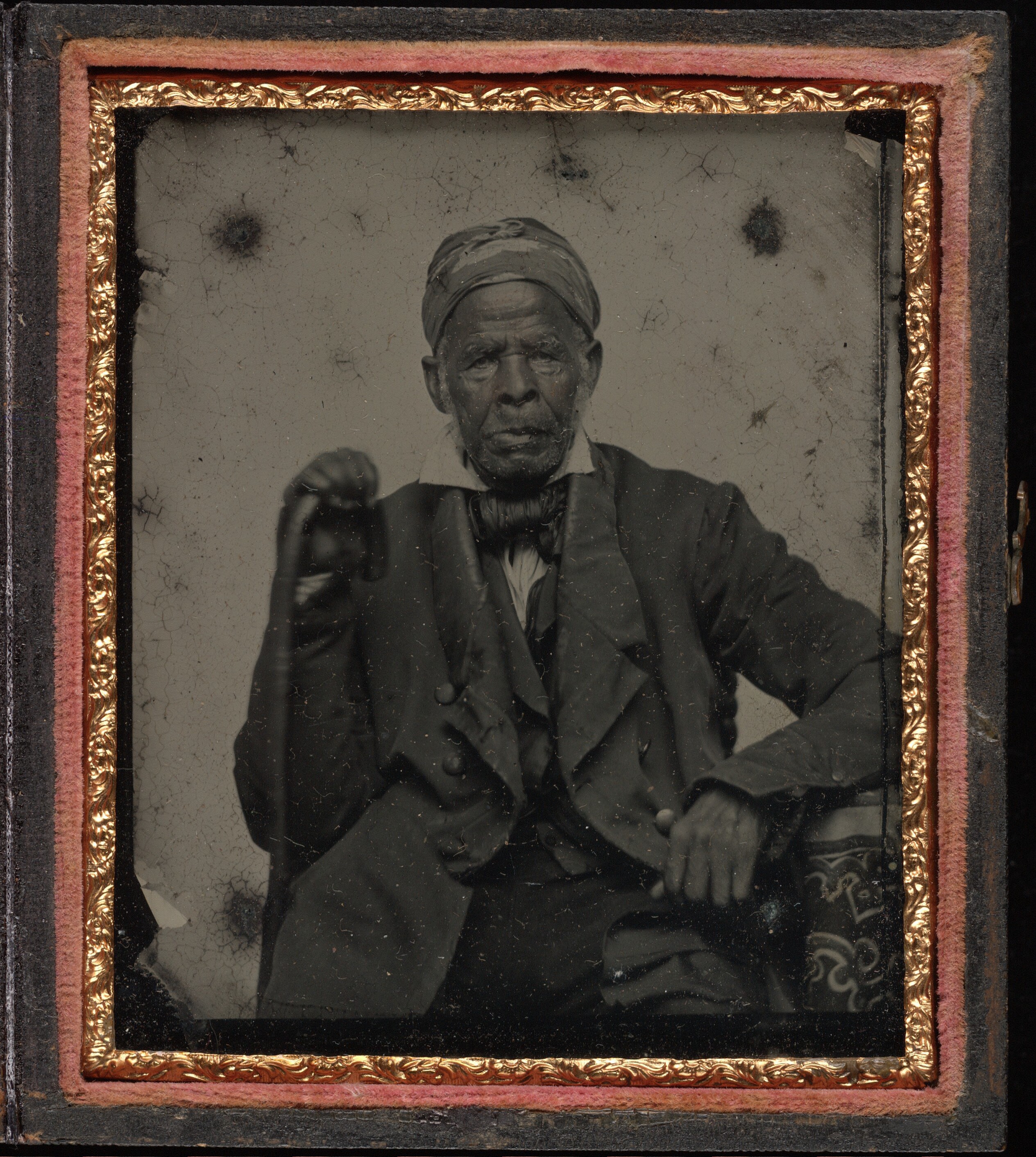
A portrait of Omar ibn Said around the 1850s. Photo courtesy of Yale University Library.
Omar ibn Said was born around 1770 in West Africa. Before his capture, he belonged to an Islamic intellectual world shaped by study, prayer, family, and learned transmission. The Library of Congress describes him as wealthy and highly educated. His 15-page autobiography, The Life of Omar ibn Said (1831), is the only known extant narrative written in Arabic by an enslaved person in the United States.
It begins:
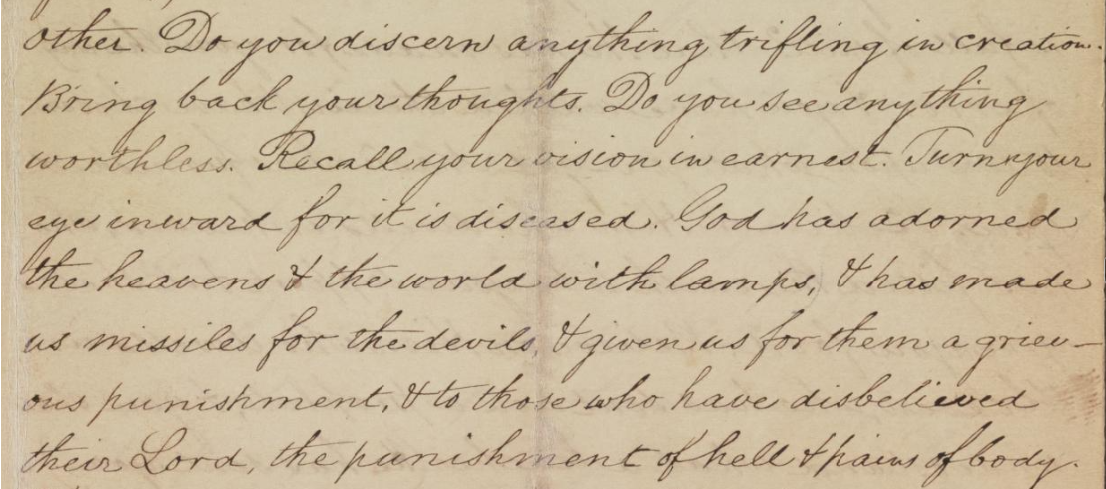
My name is Omar ibn Said [’Umar ibn Sayyid]; my birthplace is Futa Toro, between the two rivers. I sought knowledge in Bundu and Futa. The shaykh was called Muhammad Sayyid, my brother, and Shaykh Souleymane Kumba and Shaykh Jibril Abdal. I continued seeking knowledge for twenty-five years. I came back home for six years. Then there came to our country a large army. It killed many people, and brought me to the big sea, and sold me into the hands of a Christian [white person] who bound me and sent me onboard the big ship in the big sea.
The opera starts with that historical wound, and then restores the free world that preceded it. Act I opens in Futa Toro in 1806, with Omar chanting Qur’anic verses and his mother, Fatima, leading the village in prayer; soon the community is overtaken, Fatima is killed, and Omar is forced into captivity. The opera’s sonic landscape fractures violently during the kidnapping scene, abruptly replacing serene Islamic prayers with aggressive, discordant orchestral movement. To underscore the profound alienation of the Middle Passage, the audience is immersed in the dense, grief-laden laments of the community trapped within the ship’s hull, into which Omar’s voice is subsumed. This sequence gives the opera its ethical architecture. Giddens and Abels present Omar’s African and Islamic formation before the Middle Passage, the slave market, the plantation, and the jail, thereby resisting a narrative that depicts Black life from the moment of enslavement. Omar arrives in America as a fully-formed person with his own memories, teachers, personal devotions, and intellectual habits. The brutality of his captivity becomes more tangible because the opera first establishes a rich pre-life that is then unconscionably violated.
The Library of Congress preserves one detail that is especially vivid. After Omar escaped his first enslaver and was captured in Fayetteville, North Carolina, he began writing in Arabic on the walls of his jail cell. The act drew attention from townspeople, who wondered who he was and where he came from — indeed, what the strange hieroglyphs on the walls meant. Confinement became the surface onto which memory, prayer, and intellect were newly superimposed. Those who saw his writing encountered the mystery of the script long before they understood its meaning. Omar’s gesture still carries unmistakable potency: he wrote himself into — onto — this nation.
Opera is uniquely suited to honor such a gesture, turning presence into sound. The voice projects inwardness into public space; it gives memory duration, prayer resonance, and thought a body. In Omar, Giddens and Abels render the title character as more than a historical subject. He is an envoiced presence, a consciousness heard roiling across the distance between 19th-century manuscript pages and the 21st-century stage. The co-creators’ careful mediation of his voice is a signal act of archival recovery.
Giddens describes Omar as both the story of one man and the story of many, acknowledging that the operatic Omar represents but one possible interpretation of his writings and life. That quiet humility gives the opera its moral compass. Its sound, too, is multivalent and reveals a decided shift once Omar is in America. Omar’s prayers transform from an open, communal celebration to a restrained, subversive undercurrent. The score masterfully interlaces the fluid traditional Qur’anic melodies of his homeland with early African-American spirituals, gospel-tinged inflections, and the distinct twang of the banjo, blending the mournful ache of the blues with the differently-tinged hope of Christian hymnody. This strategic musical camouflage allows his original devotion to endure, transformed into a radical, acoustic act of psychological resistance.
In I Cannot Write My Life: Islam, Arabic, and Slavery in Omar ibn Said’s America, the scholars Mbaye Lo and Carl W. Ernst interpret Omar’s surviving Arabic writings, identifying the Qur’anic, theological, juridical, and literary materials that earlier readers repeatedly missed or distorted. Lo and Ernst show that Omar’s voice had been obscured for nearly two centuries by mistranslation, proslavery apologetics, and romanticized fantasies of benevolent enslavement. The opera’s final movement aptly makes writing the central act of survival.
Julie, an enslaved woman who first meets Omar at the Charleston slave market, recognizes the inherent power of his ability to read and write. She urges Omar to write a book, spellbound by what she knows can be an act of conservation. Her urgency — coupled with the spirit of Omar’s mother, Fatima — gives the opera a profoundly moral pulse: the enslaved community needs Omar’s testimony. His memories belong to the historical record, and they ensure a life beyond the existing frameworks of injustice silencing them.

LA Opera's production of Omar
The score carries the musical expansion of Omar’s soundworld with capacious abandon. Michael Abels describes the music as shaped by the many cultures flowing through Omar’s life, hearing the broader Muslim diaspora alongside the musics of Senegal, together with transcriptions of spirituals and hymns from the church. Communal singing, a cornerstone of the Black community and its rich African and African American traditions, makes up the central fiber of the opera.
That musical plurality underscores the opera’s American argument. Omar ibn Said’s America sounds through several inheritances at once. The score lets West African memory and Islamic devotion inflect Black American song; it allows vernacular string traditions and Giddens’s own scholarly and performance expertise with the banjo to press into choral and orchestral lyricism. “American” here poignantly means the full documentation: Arabic script in North Carolina, Islam in the slaveholding South, African scholarship in the archive of American letters, and a Black community singing their own survival.
Omar was co-commissioned by Lyric Opera of Chicago, Spoleto Festival USA, Carolina Performing Arts, San Francisco Opera, LA Opera, Boston Lyric Opera, and Detroit Opera. At Lyric, Omar arrives as a work the company helped bring into being and as an urgent encounter for a city shaped by migration, Black cultural achievement, religious freedom, and contested public memory. Omar lived for decades in a Christian slaveholding environment, and white observers often narrated his life as a story of conversion. The surviving writings — and the opera — test that comfortable tale. In the slave owner Owen’s study, he gives Omar a Christian Bible written in Arabic and asks him to write “The Lord is my Shepherd.” Omar instead writes, “I want to go home.” The sentence opens outward over the entire drama. Home may mean Futa Toro, lost family, spiritual return, freedom from captivity, or a place beyond the grasp of any “master.” The moment turns imposed piety into vulnerability and self-disclosure. Owen seeks proof of conversion and prestige within his community. Omar answers with defiant longing.
His later encounter with Psalm 23 deepens the same tension. We find Omar reading the Bible under a tree, asking Allah for the meaning of his journey, and reinterpreting the psalm from the perspective of an enslaved Muslim. Familiar scriptural imagery acquires new urgency when sung by a man whose memory of water encompasses the Atlantic crossing and whose experience of lordship involves human bondage. The aria becomes an act of disruptive interpretation under constraint. Omar reads across traditions while retaining the integrity of his own address to Allah.
The joys of Omar reside in the survival of his intellectual presence. Omar remained enslaved, a fact preserved at the center of the opera’s moral gravity. Yet his life exceeds the category imposed upon him. The word “slave” may name an unjust law’s claim upon him, but it cannot repudiate the scholar at work, the Muslim at prayer, the son formed by maternal memory, and the witness who inscribed his words before the world. His intellectual life appears in manuscripts, quotations, scriptural memory, translation, and the ongoing labor of interpretation. The mystery remains part of the dignity.
Giddens acknowledges that Omar continues to exceed any single rendering. It allows the voice of the faithful man to sound in the present while preserving his resistance to possession by archives, scholars, translators, performers, or audiences. His voice reaches us today through Giddens’s and Abels’s mediation, which preserves his complexity. In this year of America 250, Omar places our nation’s founding beside the lives its ideals failed to protect. It recognizes Arabic writing within the corpus of America’s history. It places Islam inside the soundscape of the American South. It asks the opera house to hear an enslaved man as an intellectual agent whose writings still echo across time.
To hear Omar, then, is to hear America expanded. The work gathers our nation’s wounds into music while honoring the brilliance that survived them. Omar ibn Said’s life belongs to America with its contradictions intact. His Arabic words, his Islamic learning, his acts of interpretation, and his longing for home still vibrate with meaning. Giddens and Abels give those traces sound. As a work that can be heard as a commemorative correction, Omar remembers what celebration alone can leave out, and asks us to listen with the seriousness that justice requires.
Dr. Justin Vickers is Distinguished Professor of Music at Illinois State University. Author of the forthcoming Benjamin Britten and the Night: Thresholds and Constellations, he is the editor of five books, including Childhood and the Operatic Imaginary since 1900 (Oxford, 2026) and Britten in Context (Cambridge, 2022).