March 12, 2026
A Dream of Life and Death
The composer’s first foray into opera continues her abiding commitment to riveting musical storytelling.
Gabriela Lena Frank’s El último sueño de Frida y Diego is indeed her first opera, but it is preceded by decades of experience as a composer who knows how to tell a story through a great variety of instrumental combinations and across multiple genres. As a virtuoso pianist and accomplished violinist, she has learned her craft deftly and deliberately — she is an accomplished performer, composer, and teller of history. Starting as a young, gifted musician, Frank received a rigorous conservatory training that began at the Shepherd School of Music at Rice University and culminated with her doctorate at the School of Music at the University of Michigan. Her approach to writing music includes asking questions and partnering closely with other musicians.
“Since my earliest student days as an undergrad, I will grab friends and just ask them a lot of questions about their instrument,” she noted in an interview for a scholarly work on influential women in contemporary music. “I will often have little snippets of music I’ve composed, little combinations of things I’ve tried, and I want to see if they work — and if my friends have suggestions for how to make them more comfortable.” This collaborative practice and approach has been a hallmark that has continued through numerous residencies with leading orchestras and string quartets as well as at many educational institutions. In an interview after her 2013/14 residency with the Detroit Symphony, she mentions a special climactic figure that is only in the basses because, in that city, “I got to know the bass section well.”
In addition to writing for full orchestra and multiple kinds of smaller ensembles (she also performs as a concert pianist), Frank has written extensively for voice in solo songs, a cappella chorus, and accompanied voices with chamber ensembles as well as the orchestra. Behind El último sueño, which premiered October 29, 2022 at San Diego Opera (and was performed on the West Coast also at San Francisco Opera and LA Opera), is a composer who knows how to handle vocal and orchestral forces and remains a master at collaboration.
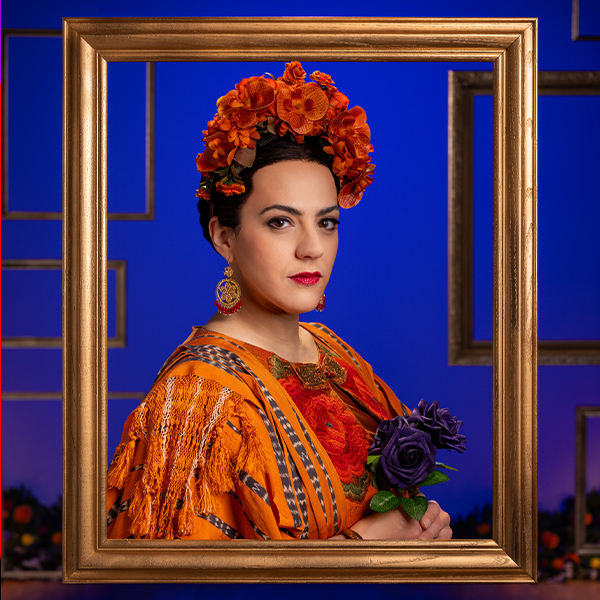
The “last dream” in the title encompasses the ethereal nature of in-betweenness that is threaded throughout the opera. We see this in the space between Earth and the underworld, living and the afterlife, a fleshy embodiment and the numinous spirit. Frank set Frida as a mezzo-soprano who extends to the top of the staff and down to the lower timbres at the bottom of the part’s range. Frida’s vocal writing and expressive orchestration give voice to the complexity of pain — a physical and emotional reality she sings about in her first entrance:
In life I had two major accidents: the impact of a trolley, and the blow of meeting Diego Rivera. The world was torture…. the pain… Agony!
In a sonic landscape that creates a permeable passage between the heaviness of the past and present, Frida ultimately accepts the opportunity to return to the living. Importantly, this decision is not primarily made to accompany Diego through death, but rather to take up the challenge her fellow underworld artist Leonardo voices: to “paint a new Frida without anguish, without indifference, without pain.” This opera reanimates the power of art as a force that makes the weight of the world worth carrying.
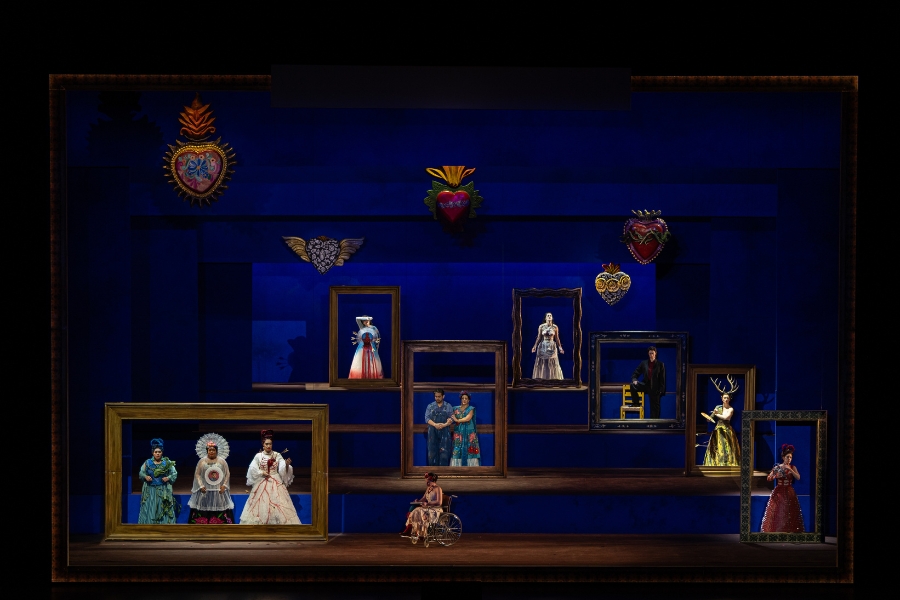
Frida Kahlo’s works come to vivid life on the stage.
Frank’s long-time association with Nilo Cruz, Cuban-American playwright and librettist who won the 2003 Pulitzer Prize for Drama for his play Anna in the Tropics, has brought the organic storytelling aspect of her music to the forefront. They met in 2007 and collaborated on several smaller scale works (including the song cycle La centinela y la paloma, 2010; Journey of the Shadow, 2013; and Las cinco lunas de Lorca, 2016) before Conquest Requiem (2017), an extended work for chorus with two soloists and orchestra.
Conquest Requiem can be seen as a close relative to El último sueño (2022). The requiem interweaves movements from the Latin Mass for the dead with texts in Latin, Spanish, and Nahuatl (an indigenous Aztec language of central Mexico). Conquest Requiem was inspired by the true story of Malinche (a Nahua woman from the Gulf Coast of Mexico, enslaved by the Spaniards from a young age). She was the consort of conquistador Hernán Cortés and, given Malinche’s gift with languages, she also became an interpreter who was both implicated in (and victimized by) the colonial conquest of the Aztec Empire by the Spanish.
This story about the forceful European entrance to the Americas is central to modern history, yet in this work it is not told from the usual Spanish/European viewpoint. With two soloists — soprano Malinche and baritone Martín Cortés (Malinche’s son with Hernán Cortés) — a large part of the narrative is sung in Nahuatl from the vantage point of the conquered. The requiem is a study of blending the western history of Europe (in the Catholic mass and use of Latin and Spanish languages) with a less familiar indigenous voice of the Americas.
In the dynamics between the paired mezzo-soprano and baritone central characters (Malinche and Martín, Frida and Diego), the use of multiple languages and vibrant orchestration illuminate the larger philosophical themes of legacy and cultural representation in Latin American stories.
Conquest Requiem illustrates other central features of Frank’s music that figure prominently in El último sueño de Frida y Diego. The seven-movement work features the musical transition between life and death, themes that encompass our behavior on earth and the passage into the beyond. This borderland between the living and the dead is the site of the opera’s true setting, the locus of Frida’s mission to help her earthbound widower, Diego, peaceably pass into the afterlife.
An important role in the opera is Catrina, the Keeper of the Dead, who summons Frida to return to Earth. Written for high soprano, the trickster-like character mirrors the dual nature of Malinche, the named soprano soloist in the requiem whose alliance with Hernán Cortés opened the path to exploration and collaborative beginnings as well as to exploitation and devastating ruin. The choral writing in both large works helps bind each story together as the chorus creates a sonic landscape delineating life on Earth and the existence beyond.
The sound worlds of both earthly life and the imagined afterlife come alive especially through one important signature of Frank’s orchestral style, her expanded virtuosic writing for percussion. In the two compositions, she constructs innovative soundscapes through marimbas, xylophones, tubular bells, cymbals, triangles, tam-tam, snare drum, and various other instruments specific to each work. The requiem adds the low wood block, thunder sheet, and bass drum; the opera includes high wood block, rainstick, handbells, small nipple gong, mark tree, and celesta.
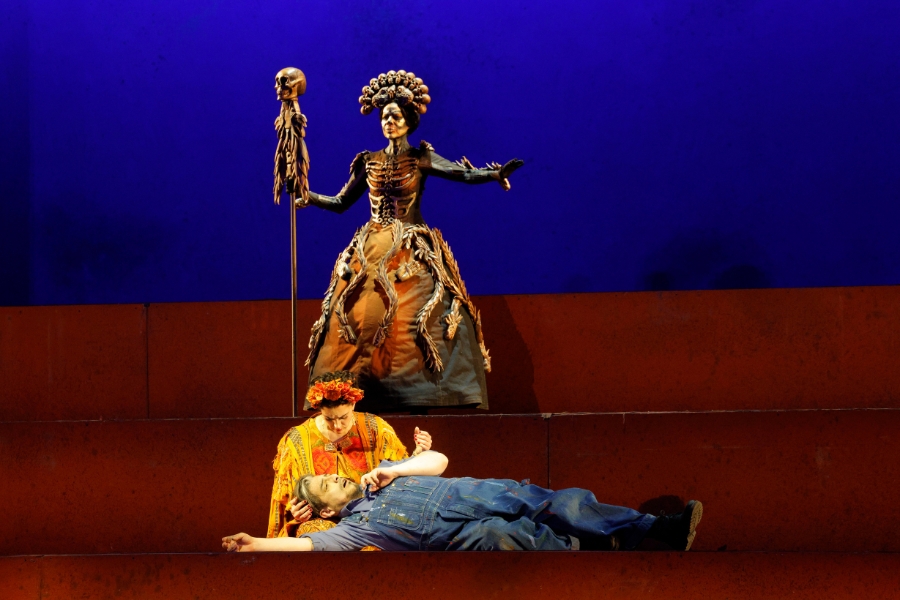
Catrina calls for the god of the underworld to bring Diego to the world of the departed.
With this opera, Frank adds an important work and voice to an arena in opera that is only recently getting attention. Her combination of language, Latin American history, and stories told from lesser-known vantage points are bringing experiences that have been hidden in the shadows into better visibility. Most seasoned opera-goers are not accustomed to hearing operas in Spanish — this production is just the second on Lyric’s stage — or even to seeing stories about Latin American diasporic experiences, though Spain (and especially Seville) were popular settings for operas ranging from the late 18th century (The Marriage of Figaro and Don Giovanni) and into the early 19th century with Beethoven’s Fidelio (1814) and Rossini’s The Barber of Seville (1816). Later in the 19th century are operas by Verdi (Ernani, Il trovatore, La forza del destino, and Don Carlos), and — most famously — Bizet’s Carmen, among others.
Frank’s opera joins a growing number of productions that are sung in Spanish and reflect elements of a diasporic culture that goes beyond an imagined exoticized locale. An early start to this tradition extends back to Brazilian composer Antônio Carlos Gomes, who trained in Italy and wrote eight operas in different languages (Portuguese and Italian), most famously Il Guarany (1870). Manuel de Falla, born in Spain, wrote zarzuelas and operas in Spanish (La vida breve, 1905).
While this is a music history still being written, audiences in recent decades have experienced a newer group of operas sung in Spanish that showcase Latin diasporic stories, exemplified perhaps most prominently in Daniel Catán’s 1996 Florencia en el Amazonas (with a libretto by Marcela Fuentes-Berain), a vivid work that incorporates Gabriel García Márquez’s magic realism. Osvaldo Golijov’s Ainadamar (in Arabic, “Fountain of Tears”) was composed in 2003 (revised in 2005) and has a libretto by David Henry Hwang that was translated from English into Spanish by Golijov. An “opera in three images,” the extension of “real time” showcased in Márquez’s magical realism applies to Ainadamar; in it, the story of Federico García Lorca is told in a series of flashbacks by his muse, the actress Margarita Xirgu, as time in the opera moves between the past, the present, and the moment before her death.
Though the musical languages of Florencia, Ainadamar, and El último sueño are very different, the three operas in Spanish present diasporic stories that encompass Spain and Latin America — Colombia, Brazil, Mexico, and Uruguay — in ways that move across time, language, and history. With a keen sense of their compositional voices, Frank and Cruz have sharpened the vanguard of what opera can do and say today. Through Mexican folklore of the Day of the Dead and the lives of Frida Kahlo and Diego Rivera, we are given a sophisticated collage, a new vision of history being represented on the opera stage with care, nuance, and power.
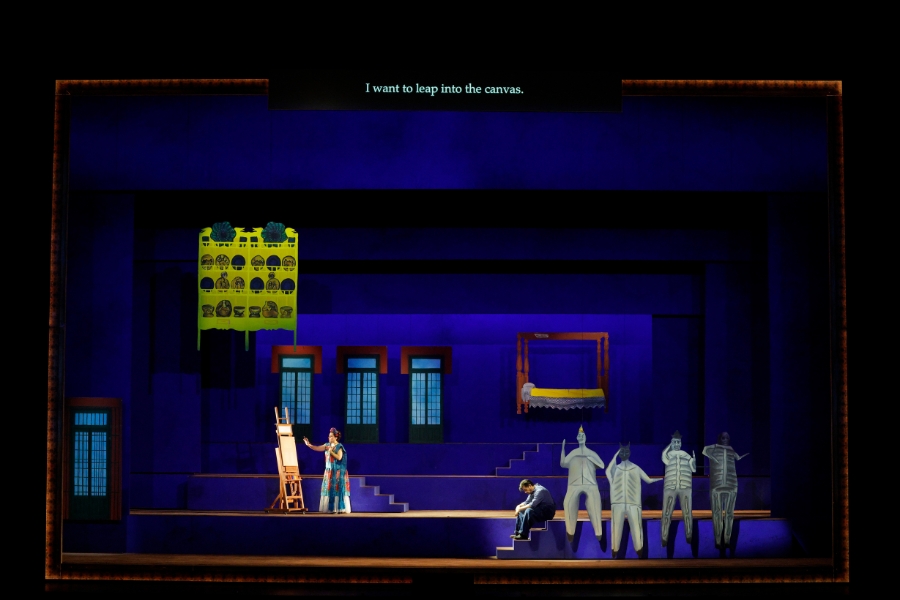
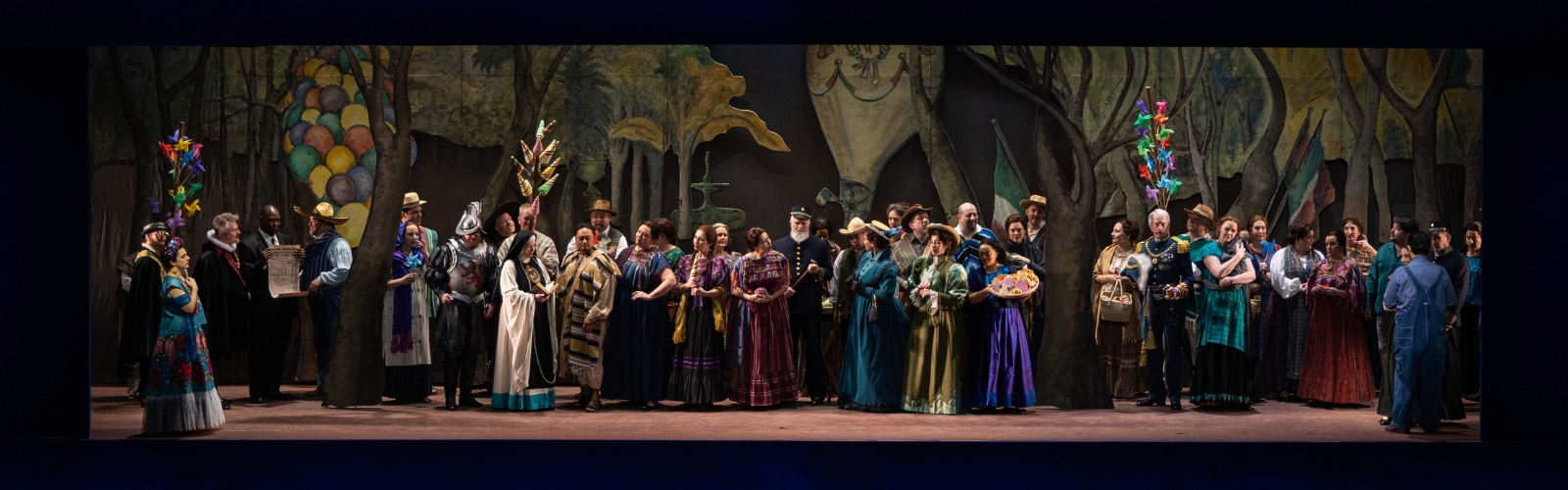
Frida Kahlo and Diego Rivera's artwork served as a major inspiration for the opera's scenic design.
Naomi André is the David G. Frey Distinguished Professor in Music at the University of North Carolina at Chapel Hill. She is the author of Black Opera: History, Power, Engagement and other projects examining opera and representation.