April 17, 2026
"safronia": an operatic journey
On May 28, 1893, in an article about his 9th symphony, also known as From the New World, the New York Herald Tribune quoted Antonín Dvořák as saying: “The new American school of music must strike its roots deeply into its own soil…. America can have great and noble music of her own, growing out of the very soil and partaking of its nature — the natural voice of a free and vigorous race.”
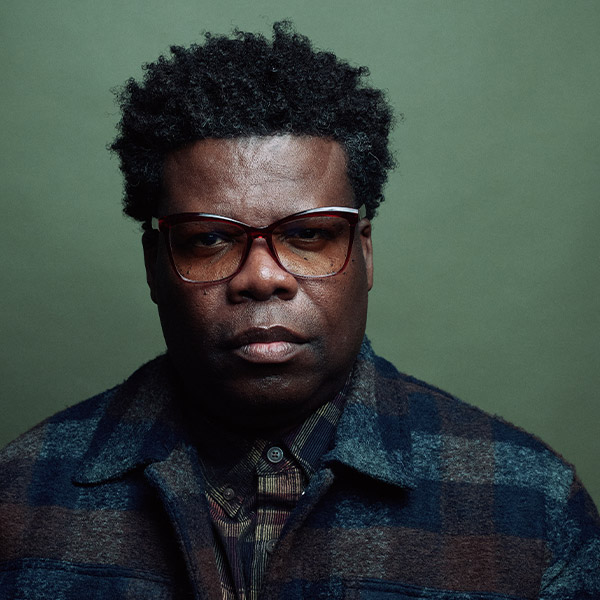
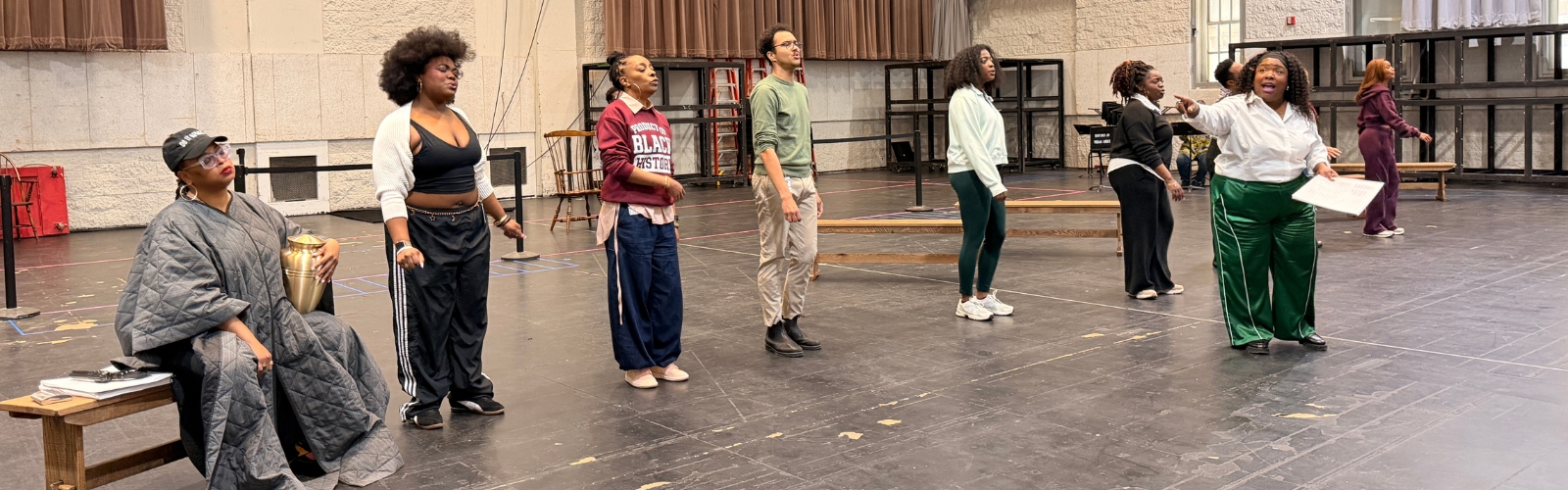
“Negro melodies,” the great Czech composer continued, should “be the true basis for a distinctively American School of Music.” In a sense responding to Dvořák’s call to action, avery r. young, Chicago’s first Poet Laureate, presents safronia, a new musical drama about the Great Migration commissioned by Lyric Opera of Chicago.
As the opera’s composer and librettist, young adopts the role of the Griot, alchemizing autobiography, storytelling, Afro-Surrealism, and Black music as key ingredients for manifesting a Black operatic offering of remembrance, repatriation, and justice.
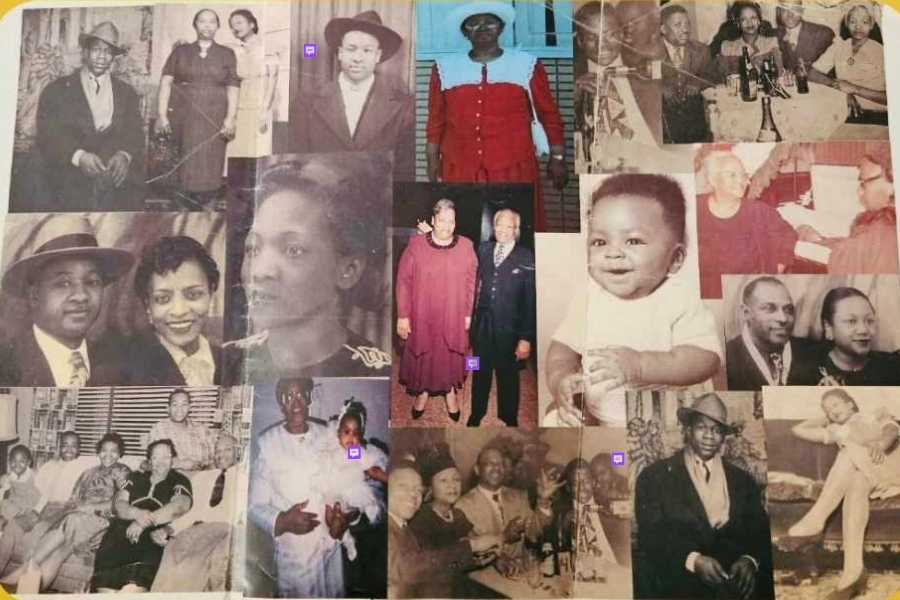
A collage of avery r. young’s extended family, whose narratives help shape the opera. 1, 2, & 3. Mary Ann Booker, young’s great aunt and legal guardian. 4. Mary Ann Booker (at right) with friends 5. A family gathering; Willie Booker, young’s great-grandfather and the inspiration for baar, is at far right.
In Black Opera: History, Power, Engagement (2022), musicologist Dr. Naomi André described Black opera as “the construction of Black experiences in opera, encompassing a variety of activities, such as operas by Black composers and librettists with stories about Black people sung by Black singers. Yet, having Black people involved in all these facets is not the only configuration for defining Black opera. Black opera can also include interracial partnerships that involve non-Black collaborators; for example, works incorporating Black narratives by non-Black writers or productions where, even if a character’s race is not specified as Black, opera companies give Black singers the opportunity to perform.” Unlike Lyric’s previous productions of Fire Shut Up in My Bones (2021/22), Factotum (2022/23), Champion (2023/24), and Blue (2024/25), safronia does not situate itself within a “classic” presentation of opera. Instead, through Black music and vernacular, young has designed an operatic experience unapologetically about, by, for, and near Black people, in line with W. E. B. Du Bois’ instructions in The Crisis (1926) — that artworks must serve as instruments for liberation.
safronia’s Booker family feels fully formed and blossoming with life because young knows the characters that shape the opera’s narrative well. His family’s Great Migration story loosely serves as the opera’s creative source material. In fact, when I asked young, “how much of safronia is autobiographical?” he replied that the work is “extremely inspired by events in the real lives of my great-grandfather and great-grandmother, Lillie Mae and Willie Booker.”
The Bookers — baar (patriarch), magnolia (his wife and matriarch), safronia (their daughter), and king willie tate (her husband) — function as the narrative’s primary family unit. They also serve as a quadriptych of archetypes representative of Black Americans’ individual responses to embodied and lived anti-Black trauma. baar and safronia self-soothe the forced abandonment of their dream of building a school on their land with alcohol; magnolia and king willie tate’s pragmatism compels them to prioritize survival over everything else. However, young’s creative vision remains incomplete if audiences do not empathize with the Bookers’ plight by considering two critical questions: How would you feel, and what would you do, if some uncontrollable force stole your birthright and inheritance?
In The Difference Between White People and Whiteness, a recent essay on the Radical Roundtable website, Keryl McCord challenges readers to identify “whiteness” as a system versus a group of people, suggesting that people may opt in and out of white identity as they evolve over their life spans. The distinction proves useful in understanding the motivations of safronia’s two non-Black characters, bossman and cholly. safronia differentiates European Americans from people who have been tricked into believing that they are white for the nefarious means that President Lyndon B. Johnson articulated in a conversation with Bill Moyers. “If you can convince the lowest white man he’s better than the best colored man, he won’t notice you’re picking his pocket,” Johnson said. “Hell, give him somebody to look down on, and he’ll empty his pockets for you.”
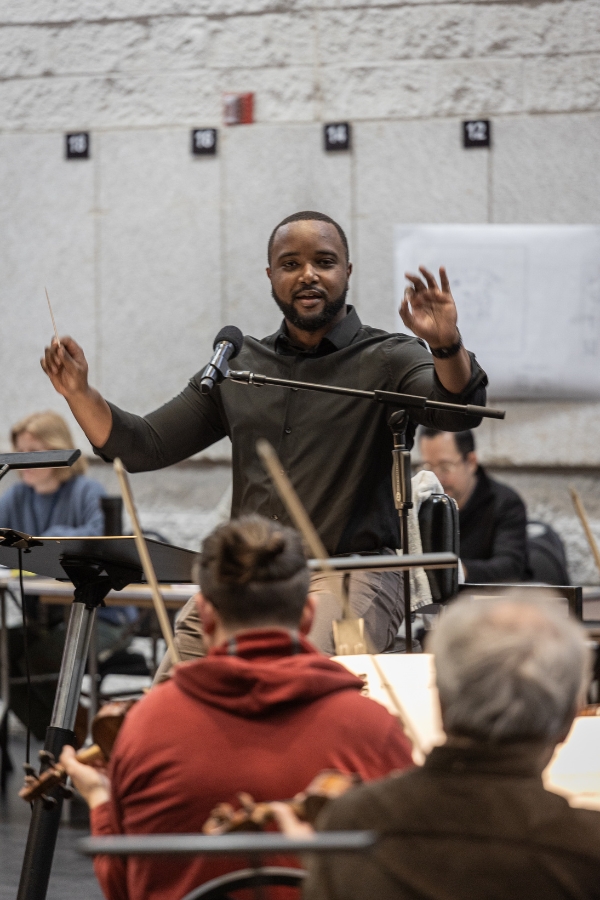
Paul Byssainthe, Jr. conducts during a workshop of safronia.
As singing characters, young positions bossman (countertenor) and cholly (bass-baritone) on opposite ends of the vocal spectrum so that audiences view them differently, at least on the surface. cholly’s betrayal of his alleged friend baar proves heartbreaking, revealing how sometimes interracial friendships struggle under the weight of whiteness. It’s a potent circumstance that makes for epic operatic storytelling.
The journalist D. Scot Miller, an expert in the subject matter, defined Afro-Surrealism in part as both “interested in the present and visiting the past with fresh eyes” — aptly describing the style of safronia, in which young deploys and upends language, time, space, and sound to tell the Booker’s story in nonlinear fashion. Foregrounding the musical descendants of Negro Spirituals, young fuses blues, funk, gospel, and hip-hop to conjure safronia’s Black sonicity. He aims for audiences to listen intently to sounds of Blackness and also to position Black Americans’ music as “America’s classical music.”
Indeed, many musical idioms birthed in the U.S. can trace their roots back to Negro Spirituals. Still, listen carefully for the transformations that blues, funk, and gospel undergo in safronia as a result of the Great Migration. “The music is about what is birthed from musicians going North,” young says. “Blues gets electric once it goes up North. But the conditions don’t switch, especially when you’re talking the Blues, or Gospel, or any of it.” Both leddem in and norf, among other movements, will likely inspire audiences to tap their feet and move to the music in their seats, as young intends. But Afro-Surrealism also enables the music to create a dream-like state. “How do I start at Curtis Mayfield and push it further, in this story about time travel and how music has, or Black music has, traveled time?” young muses. “It’s magic to propel us forward and it’s magic to make us remember. So, we have hymns and blues that make us remember — and we have hip hop and funk to prove it.”
Similar to the Booker family, between 1910 and 1970 some six million Black Americans (descendants of Freedmen) moved from the South to Northern, Midwestern, and Western states, including Alaska. The transatlantic slave trade, U.S. Civil War, and Reconstruction preceded the Great Migration, a period of such cultural, economic, historical, political, psychological, and social import that safronia immediately enters into dialogues with iconic works such as The Warmth of Other Suns, The Harlem Renaissance and Transatlantic Modernism, The Migration: Reflections on Jacob Lawrence, Sky Full of Elephants, and, most recently, Sinners, among others. So why did Black Americans flee the South?
Although the U.S. promised Black Americans a new social contract replete with citizenship, freedom, and equal protection under the law after the Civil War, Black Americans fled the South to escape the Jim Crow system, which governed peoples’ actions and interactions while masterfully dispensing state-sanctioned brutality, cruelty, fear, and treachery. For far too many Black Americans, the “American” dream felt — and continues to feel — like an “American” horror story.
In her 2017 TED Talk, The Great Migration and the Power of a Single Decision, Isabel Wilkerson (author of The Warmth of Other Suns: The Epic Story of America’s Great Migration) noted that “every four days a Black person was lynched for some perceived infraction of protocol.” It is a grim footnote to observe that Hitler sent Nazis to the U.S. to study Jim Crow in order to replicate and amplify its methods in Germany. “The Great Migration was the first time that American citizens had to flee the land of their birth just to be recognized as the citizens that they had always been,” Wilkerson says. “No other group of Americans have had to act like immigrants in order to be recognized as citizens. This Great Migration was not a move; it was a seeking of political asylum within the borders of one’s own country.”
No one knows the exact number of African souls lost due to the socially engineered false racial hierarchy that some call the Black Holocaust. The Great Migration is “a shared narrative,” young notes, “but it’s not a monolithic narrative.” Cultural, physical, psychological, and spiritual distance from the South’s racial caste system did not relieve Black Americans of America’s problems in the North. In fact, some Black Americans came to believe that they would have been better off staying in the South; the promised safe haven from structural and systemic racism did not materialize. “People are trapped in history,” wrote James Baldwin in 1955’s Stranger in the Village, “and history is trapped in them.”
Although Black Americans continue to make the Great Migration today, in 2021’s The Devil You Know: A Black Power Manifesto, writer Charles Blow (whose memoir was the source material for Fire Shut Up in My Bones) argued that Black Americans living outside of the South should return in a reverse Great Migration to reclaim stolen political power. His hypothesis compels the question: Can anyone claim to have achieved freedom and justice if forsaking their place of birth brought them to a fate similar to what they would have endured had they stayed?
In responding to the Great Migration’s harm and violence, to artistically “make things right,” young answers the question by repatriating baar to his land. “That’s all Big Mama wanted to do. She wanted to go back South when she retired because she said her grocery store would be in her backyard,” young says. “One of the elements of the piece is this nostalgia that baar and safronia suffer from, or are trying to cope with. baar and safronia don’t really want to go up North. They would rather fight to the death and stay on their land.”
If the grand art form of opera has another 400 years to hold our attention, let us hope it is with more operas like safronia — works that move us in the direction of truly transformative justice for us all.
antonio c. cuyler, ph.d. is Professor of Music in Entrepreneurship & Leadership at the University of Michigan. He served as Lyric’s inaugural Scholar-in-Residence during the 2024/25 season. HisCreative Justice in Arts and Culture: Global Perspectives, co-edited with Mark Banks (University of Glasgow), is forthcoming from Palgrave Macmillan.