March 04, 2026
"Madama Butterfly": Between fantasy and (virtual) reality
This new production offers a boldly relevant, gorgeous reimagining for the present day.
When the curtain rises on Matthew Ozawa’s new production of Giacomo Puccini’s Madama Butterfly, we see the dimly lit interior of a room furnished with sleek, modern furniture in neutral colors. The exception is the red and black gaming chair, center stage, whose colors echo those in the room’s posters of women in kimono. The door opens and Pinkerton, wearing a T-shirt and a pair of slacks, enters. He grabs a can of beer, sits, and puts on a virtual reality headset.
The stage is suddenly bathed in cold blue light; Puccini’s prelude begins. As additional characters begin to interact with Pinkerton, it becomes clear that we are now seeing the onstage action through his eyes. This is Madama Butterfly presented as a kind of artificial game world in which Pinkerton acts out an elaborate fantasy.
This provocative theatrical conceit can provide a jarring sensation, especially for audience members accustomed to standard renditions. But Ozawa’s overarching gesture immediately engages with a longstanding trope that existed in Europe at the turn of the 20th century, when Puccini composed the opera, which premiered early in 1904. Camille Saint-Saëns’s one-act comic opera, La princesse jaune (1872), for example, features a Dutch student, Kornélis, who falls in love with a portrait of a Japanese woman, Ming. With the aid of a magical potion laced with opium, Kornélis hallucinates and mistakes his cousin Léna for Ming.
Puccini and his librettists, Luigi Illica and Giuseppe Giacosa, also play with this idea; early in Act I, before CioCio-San sets foot on stage, in his aria “Amore o grillo,” Pinkerton explain to Sharpless that his future Japanese wife “seems like a figure from a screen (sembra figura da paravento).” The very voice of Pinkerton encourages the audience to experience Cio-Cio-San as a visual object. (In the exchange that follows, the kinder and more emotionally sensitive Sharpless reminds Pinkerton, and the audience by extension, to listen to her voice.)
This phenomenon — and this production of Madama Butterfly — point to the historic fact that European and American exposure to Japanese culture in the late 19th century came primarily through objects — imported prints, furniture, ceramics, and fabrics — rather than through interactions with Japanese people. Ozawa’s ambitious construct not only updates this mediated cultural process for the 21st century, but also foregrounds the work as an artistic creation rather than a documentary reflection of history. To acknowledge that a piece of opera, an inherently stylized genre, is a fictional work may seem self-evident. The significance of Ozawa’s Madama Butterfly, however, becomes more clear as we examine the performance history of the work, where cultural authenticity has often been a central concern, and consider his framing of its narrative.
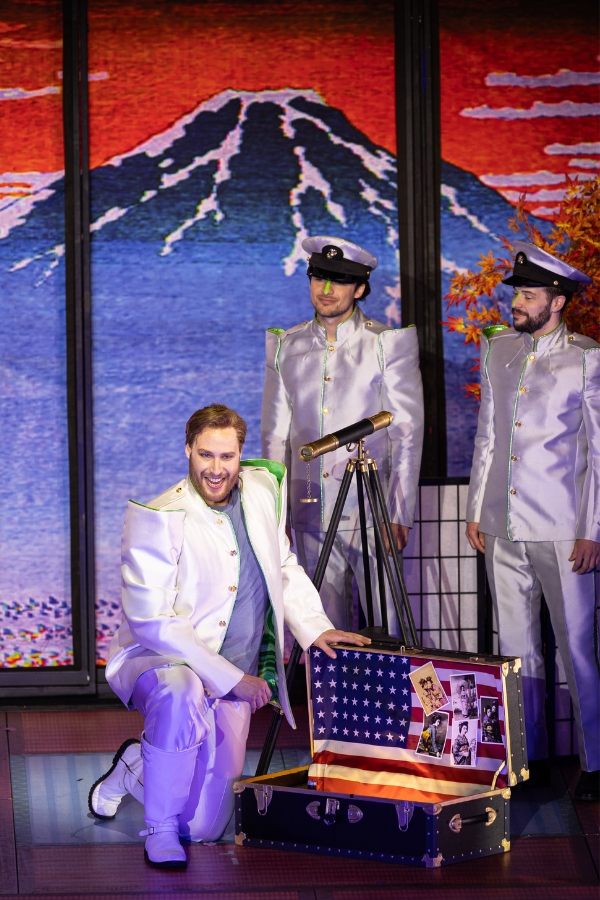
The perils of cultural imperialism have been present in the opera from its inception.
The desire to present a kind of realism in performances of Madama Butterfly began in the work’s very early stages. For the libretto, Puccini and his collaborators relied on a cluster of related literary sources written by French and American authors: Pierre Loti’s autobiographical novel Madame Chrysanthème (1887), John Luther Long’s short story “Madame Butterfly” (1898), and David Belasco’s one-act play “Madame Butterfly” (1900). Loti was stationed in Nagasaki, the setting of Madama Butterfly, as a naval officer. Long had no direct connection to Japan, but had a sister, Jennie Corell, who lived in Nagasaki with her husband, head of a Methodist mission there. Belasco, a native of San Francisco, had experience encountering immigrants from East Asia in that city.
To musically evoke the Japanese setting, Puccini made at least some efforts to understand its culture. He interviewed the wife of the Japanese ambassador to Italy, Hisako Oyama, possibly witnessed a performance of Sadayakko, a Japanese actress then touring Europe, and studied printed Japanese music that was available to him. The numerous costume illustrations for the first production at La Scala, by Leopold Metlicovitz and others (accessible at digitalarchivioricordi.com), amply demonstrate how the European artists had studied Japanese prints and art works.
Toward the end of his life (he passed late in 1924), long after Madama Butterfly had entered the repertory around the world, the composer attended a 1920 performance of the work in Rome with the Japanese soprano Tamaki Miura (1884-1946), a well-known figure in Japan, Europe, and the United States, in the title role. Puccini invited her to his villa in Torre del Lago, where they discussed Japanese music; he was at the time seeking additional inspiration for his current project, Turandot. A remarkable encounter, to be sure — though the composer reaching out to a Japanese musician while composing an opera set in ancient China indicates a somewhat casual approach to cultural accuracy.
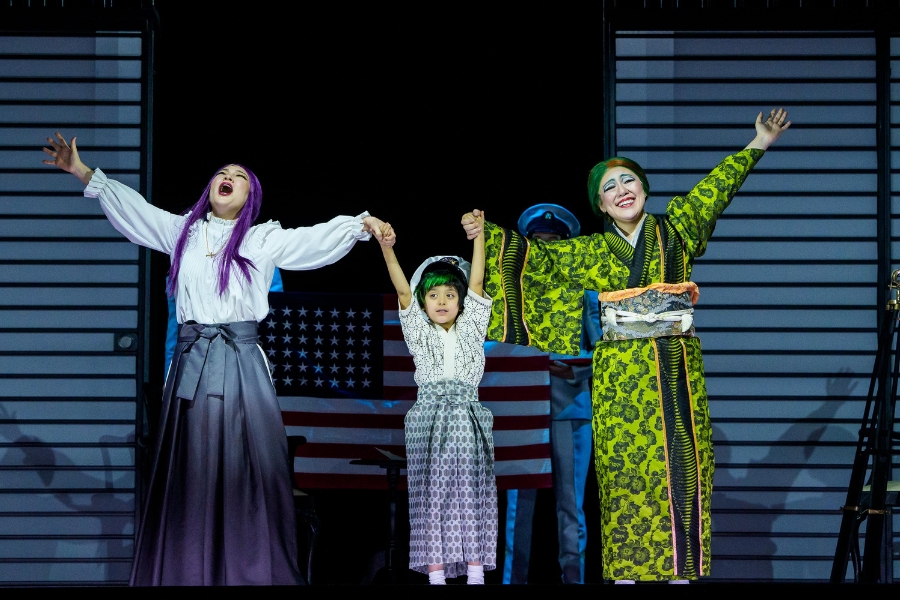
This production of Madama Butterfly treats its main character as a fantasy created by western men.
This production of Madama Butterfly by Ozawa, who is Japanese American, comes not as a disruption but a bold continuation of a long line of productions in the United States informed by artists of Japanese ancestry. In 1952, 1953, and 1956, Japan’s oldest opera company, the Fujiwara Opera, engaged in three North American tours, bringing together Japanese singers and local musicians for performances of Madama Butterfly. The Metropolitan Opera invited director Yoshio Aoyama, connected to the Fujiwara Opera Company, and the scenic designer Motohiro Nagasaka, for its new Butterfly in 1958. Following this success, in 1969 Lyric Opera of Chicago invited Aoyama to direct a new production, and participation of Japanese directors at major operatic houses continued in Europe, including Keita Asari’s stylized production at La Scala in 1986 and Yoshishige (Kiju) Yoshida’s experimental staging set in postwar Nagasaki for Opéra de Lyon in 1990.
Originally co-commissioned by Cincinnati Opera, Detroit Opera, Pittsburgh Opera, and Utah Opera, this Butterfly is also part of a group of innovative stagings by Asian and Asian American directors that have emerged in recent seasons. These productions introduced nonspeaking roles, depicted Trouble as an adult man, relocated the setting, and even had Cio-Cio-San performed as a puppet. These dislocations (and Ozawa’s) may be seen at least in part as responses to the ghosts of anti-Asian sentiments that surfaced, unexpectedly and violently, during and after the pandemic.
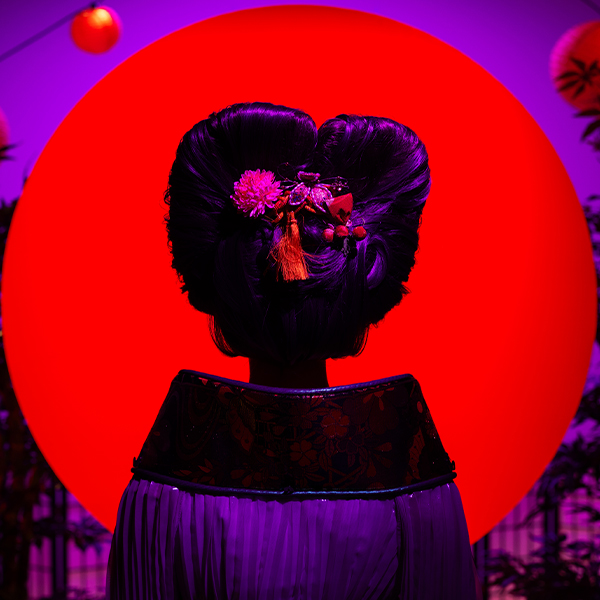
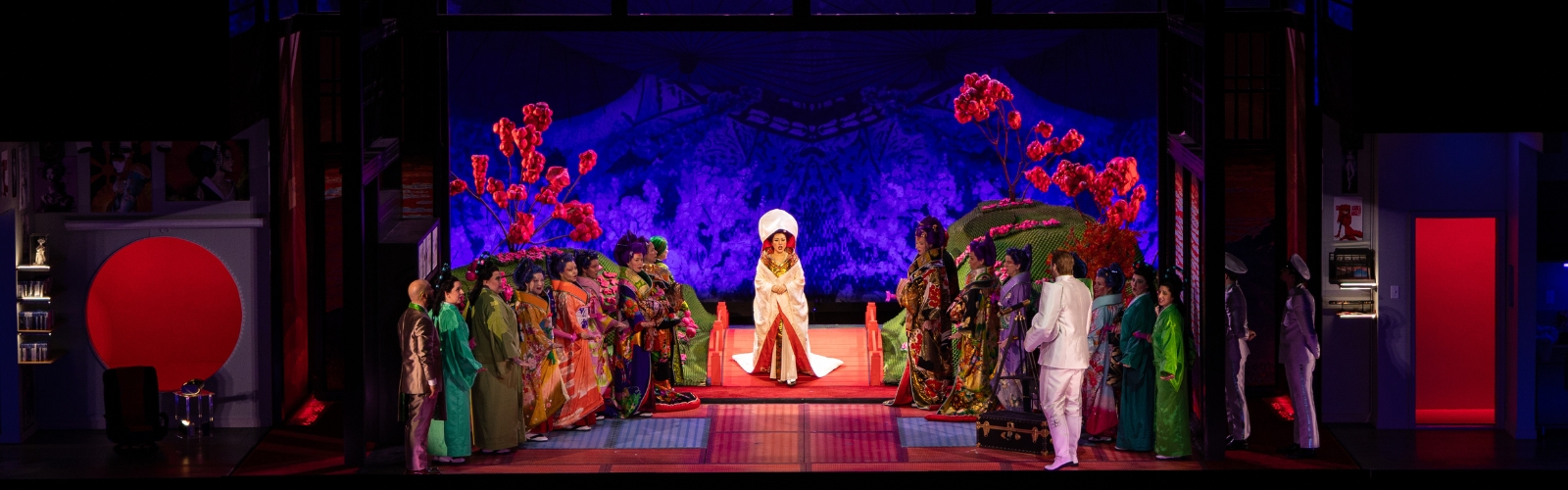
Especially notable also in Ozawa’s production is the collaborative approach he took to develop a visually stunning and intellectually engaging staging that seeks to challenge the status quo while maintaining the musical integrity of the opera. Ozawa first assembled a team of female artists of Japanese origins — Kimie Nishikawa from dots (set designer), Maiko Matsushima (costume designer), and Yuki Nakase Link (lighting designer) — who have experience working in both Japan and the United States. The collaborators initially struggled to forge a narrative in which they could see their lived experiences as Japanese women reflected in the character of Cio-Cio-San. They ultimately determined that, rather than endowing the figure of Madama Butterfly with realism, they would engage directly with the premise that she is a fictional character — one created by a group of European and American men. Forgoing the concerns about authenticity that had been central for earlier generations of Japanese artists, they foreground the artificiality of Puccini and his collaborators’ vision of Japan. The result retains the familiar musical sumptuousness of the opera, but in neon-tinged light and with costumes inspired by contemporary Japanese pop culture.
Interestingly, presenting the opera as a virtual reality game also brings about a transformation of Pinkerton. While “traditional rendition of the opera has the American naval officer as a villain of sorts,” Ozawa points out, his production reveals that the officer, too, is a victim of societal structure, “taught to love the fantasy version of Japanese people.” Pinkerton comes to a world of Madama Butterfly that has already been created to satisfy his desires. As the bright visual elements of the production mesmerize Pinkerton deeper into his escapist fantasy, we too become engrossed in Puccini’s fictional world.
At the same time, the juxtaposition of the techno-Orientalist visuals with Puccini’s familiar score has the potential to move audiences toward a kind of critical distance from the work — one that does not have to detract from but can contribute to an enriched understanding of the lasting relevance of Madama Butterfly, well more than a century after its creation. In this production, audience members who have historically struggled to come to terms with the opera’s casual, unthinking racism (often evident in ill-advised makeup and exaggerated shuffling and bowing), will see even Cio-Cio-San experience a transformation — an answer of sorts to the longing felt by many Asian women, past and present, to liberate themselves from a confining narrative of loss, self-sacrifice, and shame. This production, then, provides us with opportunities to reflect on desires, fears, and hopes that are unique to our time — to help us make sense of the world we live in.
Kunio Hara is Associate Professor of Music History at the University of South Carolina. His most recent publication on Puccini, “The Racial Politics of Madama Butterfly and Turandot” is included in Puccini in Context (2023).