September 10, 2026
The many glories of bel canto
In November, Lyric Opera of Chicago presents Don Pasquale, an 1842 masterpiece from Gaetano Donizetti — one of the titans of the opera style whose name translates simply as “beautiful singing.” This grouping of works has delighted audiences for two centuries. Here are just a few reasons why.
“Ah! mes amis” — La fille du régiment, Gaetano Donizetti
Lawrence Brownlee
“Ah! mes amis” is Tonio’s famous Act I aria from Donizetti’s 1840 French opera La fille du régiment (The Daughter of the Regiment). Tonio has joined the regiment so that he can marry Marie, and he celebrates his acceptance with exuberant enthusiasm. The aria is an outstanding example of bel canto vocal virtuosity; most famously, its cabaletta contains eight written high Cs, with a ninth commonly added by performers, making it one of the great tenor showpieces.
Although the term bel canto can be used simply to describe an approach to vocal performance, it is most strongly associated with the Italian opera tradition of the early Romantic period, especially the works of Gioachino Rossini, Vincenzo Bellini, and Gaetano Donizetti. These works combine memorable melodies and dramatic expression with the extraordinary technical possibilities of the human voice.
Sheer vocal beauty is indeed one of the most prominent characteristics of bel canto. Singers are expected to produce an even, flexible tone throughout the voice, while maintaining control over breathing, dynamics, and articulation. Another defining feature is coloratura, in which singers perform rapid scales, arpeggios, trills, runs, ornaments, and other elaborate passages. These require performers to demonstrate both vocal agility and virtuosity, and high notes in this repertoire from sopranos and tenors are among music’s most dramatic and spectacular moments.
Despite the technical demands, however, bel canto performers at the highest level are expected always to live up to the style’s name: Even highly ornamented passages must sound graceful rather than mechanical. The style therefore demands a combination of technical precision and emotional communication.
“Principino, dove siete?” — La Cenerentola, Gioachino Rossini
Teresa Castillo, Sophia Maekawa, Joshua Hopkins, and Jack Swanson
The quartet “Principino, dove siete?”(Little prince, where are you?”) occurs in Act I of Rossini’s La Cenerentola (Cinderella); Clorinda and Tisbe search for Dandini, whom they believe to be the prince, while Ramiro is disguised as Dandini’s servant and Dandini is pretending to be the prince. The comic misunderstanding allows Rossini to combine four contrasting voices into a fast-moving ensemble — each singer demonstrating their character’s real nature.
Another important characteristic of both the music and the plots of bel canto is the interplay between solo singing and ensemble writing. Rossini, Bellini, and Donizetti frequently offer scenes in which several characters sing simultaneously, with individual melodic lines combining into increasingly complex textures. These ensembles can create emotional tension, comic confusion, or dramatic excitement. Rossini became particularly famous for his rapidly developing ensemble finales, in which repeated rhythmic patterns and increasingly energetic vocal lines build toward a thrilling climax.
The principal historical period of bel canto is often considered to be 1810 to 1840, although its traditions developed from earlier 18th-century Italian opera and continued to influence numerous later composers.
A brief list of some of the style’s “Greatest Hits” gives a sense of the extraordinary creative flowering that took place in the first half of the 19th century:
Gioachino Rossini (1792-1868)
The Barber of Seville, premiered 1816
Cinderella, premiered 1817
Vincenzo Bellini (1801-1835)
Norma, premiered 1831
Lucia di Lammermoor, premiered 1835
Gaetano Donizetti (1797-1848)
Anna Bolena, premiered 1830
The Elixir of Love, premiered 1832
The Daughter of the Regiment, premiered 1840
"La figlia, vedi, pentita" from Luisa Miller, Giuseppe Verdi
Quinn Kelsey and Krassimira Stoyanova
"La figlia, vedi, pentita" ("Your child, see, repentant") is a pivotal passage within the sweeping father-daughter duet in Act III of Giuseppe Verdi's 1849 opera, Luisa Miller. The scene takes place in a room inside the family home. Prior to this moment, Luisa was coerced by the villainous Wurm into writing a letter declaring her love for him to save her father from execution. Believing her love with Rodolfo is permanently destroyed, a devastated Luisa prepares a letter to Rodolfo stating her intention to commit suicide. Her father, Miller, returns home after being freed from prison and pleads with Luisa to live for his sake. Luisa repents, tears up the suicide note, and chooses to live.
Rossini’s operas are famous for brilliant coloratura, energetic rhythms, lyrical melodies, and comic ensembles. Bellini developed the lyrical side of the tradition, creating extraordinarily long and expressive melodies. Donizetti combined lyrical beauty and vocal virtuosity with strong theatrical characterization.
Bel canto became popular partly because it gave star singers a central role in opera. Composers were encouraged to write music that showcased particular voices, while singers developed increasingly sophisticated approaches to ornamentation and vocal technique. Singers today glory in the challenges and pleasures of these works — many of which have appeared multiple times on Lyric’s stage.
"Non più mesta" from Cinderella, Giacchino Rossini
Vasilisa Berzhanskaya
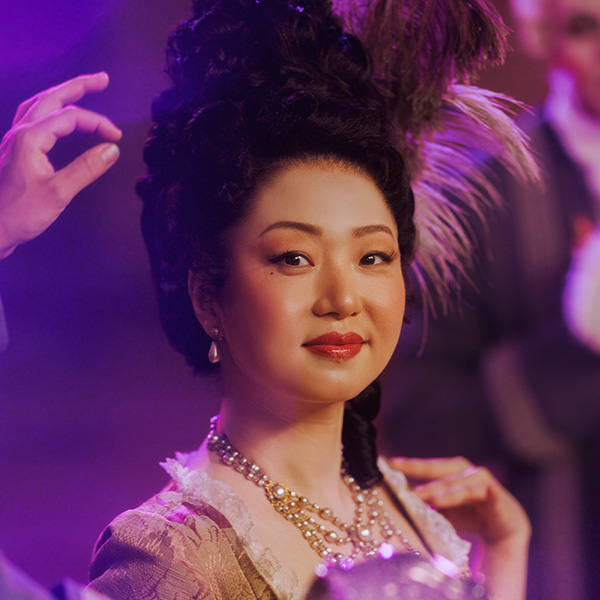
This last example needs little explanation. It’s Cinderella, as she enjoys what is sure to be a happily ever after. The devilishly difficult music expresses sheer delight.
The brief list above can credibly be supplemented by a work that appeared at Lyric Opera of Chicago at the start of the 2019/20 Season — Verdi’s 1849 Luisa Miller, performed under the baton of Music Director Enrique Mazzola, widely known as a Verdi specialist and a proponent of bel canto. Verdi’s life spanned almost the whole of the century, so while this work was actually Verdi’s 15th opera, it marks the end of his early period — or the beginning of the “middle period.” Either way, the stylistic advances in the work make use of bel canto qualities while leaving some of its overarching stylistic traits behind.
The best way to enjoy bel canto is, of course, to listen to it — ideally live. Still, the four recent Lyric performances shown below admirably demonstrate the kinds of astonishments that will be onstage soon at Don Pasquale.