September 22, 2026
Rhiannon Giddens: Making the past sing
Few contemporary American musicians have done more to expand our understanding of where American music comes from than Rhiannon Giddens. Singer, instrumentalist, composer, scholar, and storyteller, Giddens has built a career around a deceptively simple idea: that the history of music is richer, stranger, and more inclusive than the stories we have traditionally been told.
Perhaps the fullest expression of that idea is Omar, the opera she created with composer Michael Abels. Premiered at the Spoleto Festival USA in 2022, Omar tells the story of Omar ibn Said, a West African Muslim scholar who was kidnapped and sold into slavery in the United States. His extraordinary autobiography, written in Arabic in 1831, provides one of the rare surviving first-person accounts of an enslaved African in America. The opera won the 2023 Pulitzer Prize for Music, which recognized it as an innovative work that expands the language of opera while restoring the humanity of people condemned to bondage.
Lyric Opera of Chicago, a co-commissioner of the work, will present its Chicago premiere October 23 -28.
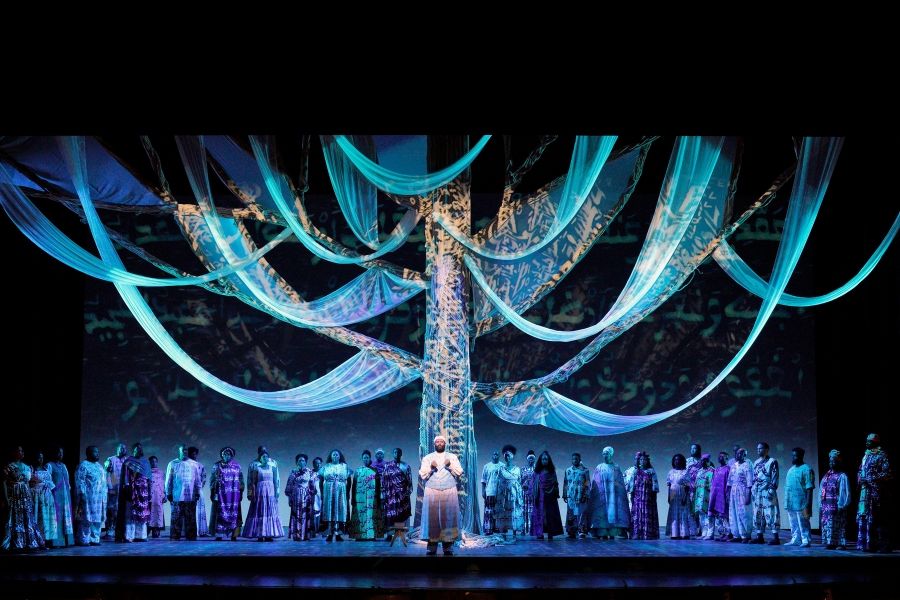
LA Opera's 2022 production of Rhiannon Giddens and Michael Abels's Omar.
The significance of Omar is not simply that Giddens brought a neglected historical figure to the stage. It is that she found an artistic form capable of holding the contradictions of his experience: African and American, Muslim and enslaved in a Christian society, scholar and captive, individual and historical symbol. “I was a North Carolinian, born and raised, never heard of Omar,” GIddens said about the project. “I was just livid.”
A righteous curiosity is central to Giddens's work. She does not treat history as a museum exhibit. She excavates it, listens to it, and then makes it live again. She became widely known as a founding member of the Carolina Chocolate Drops, an American old-time string band formed in Durham, North Carolina, in 2005. The group integrated traditional African American string band music into the modern roots landscape, reclaiming a vital piece of American musical history and reviving an area of repertoire which had been largely overshadowed by commercial country and bluegrass narratives. Playing an assortment of instruments — including the banjo, fiddle, kazoo, bones, and jug — they blended traditional old-time tunes with elements of blues, jazz, and hip-hop. The band achieved widespread critical acclaim with their album, Genuine Negro Jig, which won the Grammy Award for Best Traditional Folk Album in 2011, propelling them to international prominence. The band has been on hiatus since 2014 as the members have pursued solo projects.
Giddens has been especially important in recovering the Black history of the banjo – an instrument that features prominently in the Omar score. Her scholarship and musicianship have helped challenge the popular image of the banjo as an exclusively white, rural Appalachian instrument and demonstrated the instrument's deep African roots and its central place in the musical lives of enslaved Black Americans.
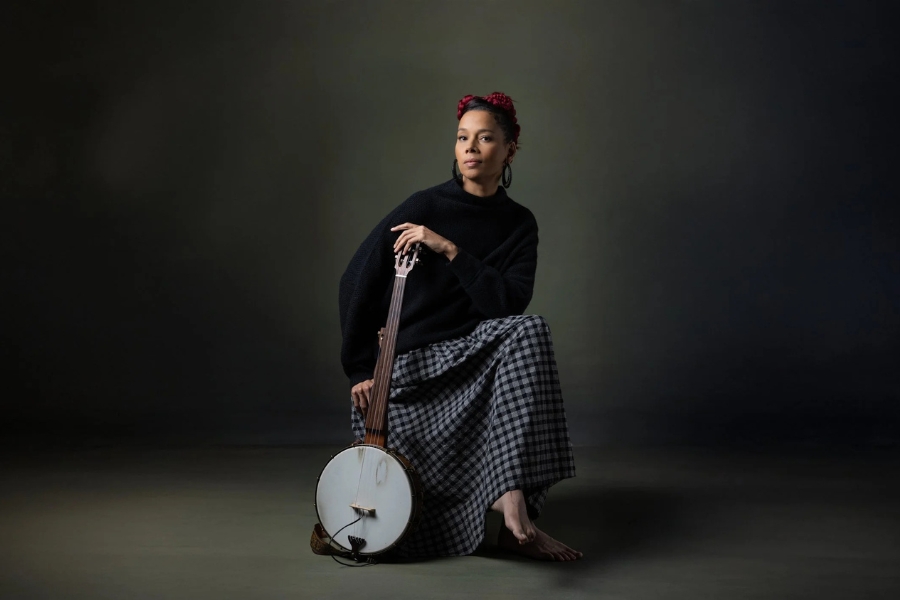
Omar co-composer Rhiannon Giddens.
That ability to combine scholarship with performance is one of Giddens's greatest gifts. Her voice can sound intimate and conversational one moment and immense the next. There is always an awareness that a song is not merely an artifact from the past but a message that has somehow survived long enough to reach us.
Omar makes this philosophy particularly clear. Giddens wrote the libretto and collaborated with Abels on a musical language that incorporates African traditions, gospel, blues, Islamic prayer, and operatic forms. Los Angeles Times critic Charles McNulty praised the work's ability to move beyond conventional genre boundaries, describing it as “too fluid to be classified in discrete musical or dramatic genres.”
That fluidity is an apt assessment of Giddens herself. She is difficult to classify because classification is precisely what her work questions. Giddens studied opera at Oberlin Conservatory and trained as a classical singer, yet she eventually found herself drawn toward the banjo and the largely hidden histories surrounding it. On albums such as Tomorrow Is My Turn (2015) and There Is No Other (2019) she delivers songs connected to the Black musical tradition while bringing her own distinctive vocal character to them. With You're the One (2023), she demonstrated an equally important capacity to move forward rather than simply backward. After years of historically demanding projects, she described wanting to “let loose and have some fun,” while exploring another side of herself as an artist.
Her return to opera through Omar therefore represents something more meaningful than a stylistic detour. It is a homecoming on her own terms. As she has explained, opera “really should be for everyone.” This work especially reminds us that American stories and music have always been made by many peoples, in many languages, under circumstances of both freedom and coercion, joy and grief. Stories omitted from our cultural memory have not necessarily disappeared — and this one will come vividly to life at Lyric this fall.