February 10, 2026
Conductor Conversation: Enrique Mazzola on “Così fan tutte”
Così fan tutte — How do you rank it among Mozart's other operas?
Number one. Well, at least in the Mozart / da Ponte trilogy, this is my favorite. Mozart has created a portrait of a special time in human life – our early 20s, maybe 18, even. Who knows? But there is no other opera in the totality of the genre that so thoroughly investigates the innocence, illusions, wishes, desires, mistakes, and misunderstandings of this special age. And we all lived through it. When you’re 20, it's difficult. When you have your first love, it's something completely true. You swear: This is the love of my life.
Is that the stuff of comedy — of an opera buffa or drama giocoso?
He's not making a joke about the immaturity of teenagers, or of young people. But he makes a drama of it, a funny drama about the adventurous moments you have early in life. Mozart is brave enough not only to make a couple of arias, but to build an entire opera on this — an opera that works, an opera that is present, an opera that in some ways, shakes morality and says, Hey, we all have been through this. Of course, the title is Così fan tutte, but it could be Così fan tutti.
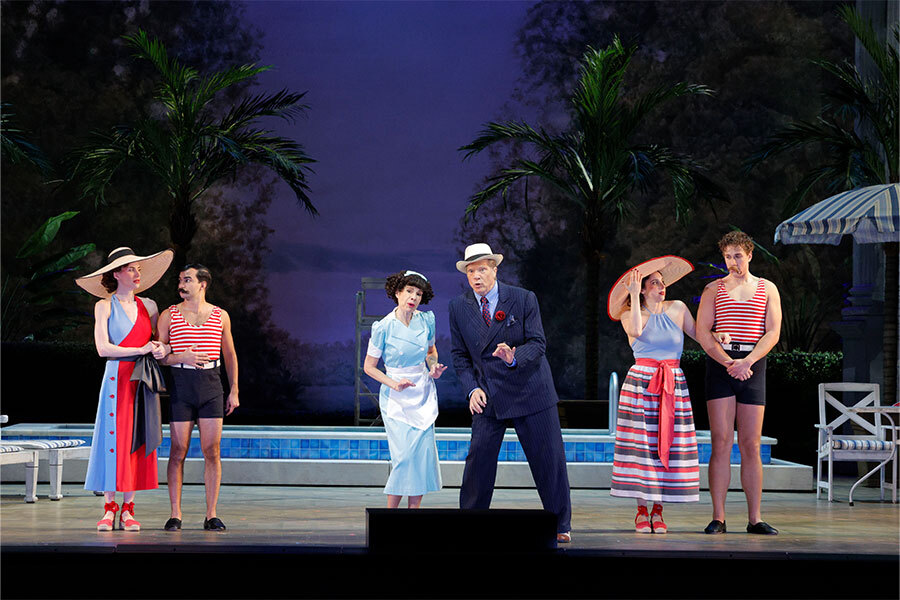
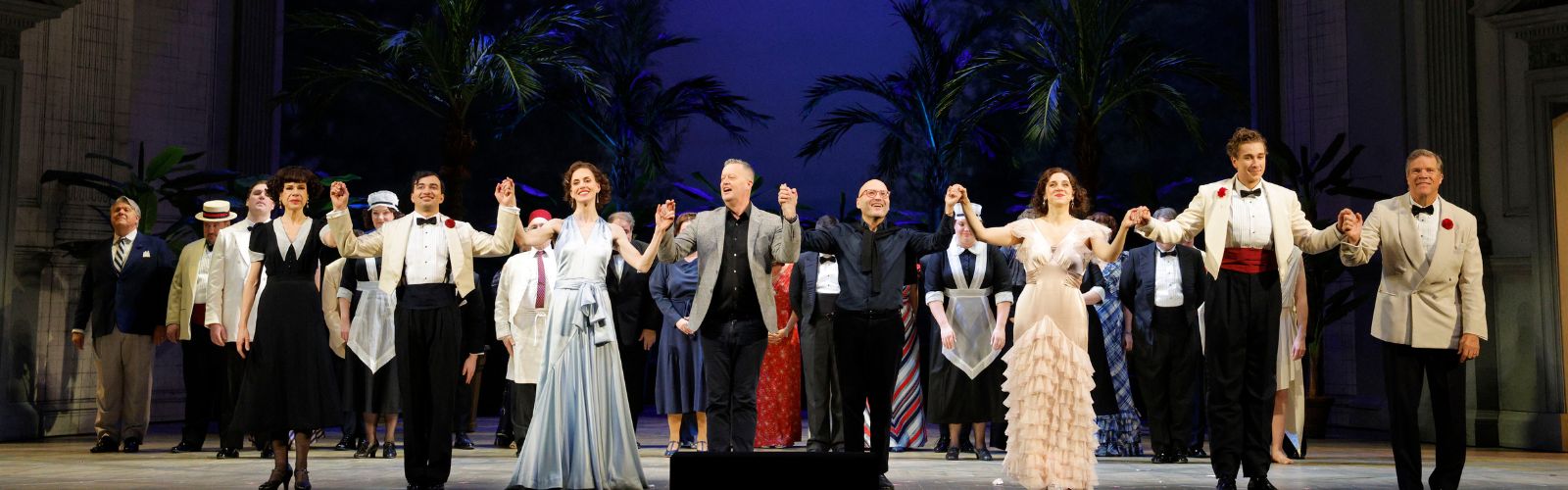
The company of Così fan tutte (from left to right) Jacquelyn Stucker, Anthony León, Ana María Martínez, Rod Gilfry, Cecilia Molinari, and Ian Rucker.
Are the women play-acting at the start?
Well, what’s in the score? I'm inclined to believe that the sentiments are true in the beginning, especially about the departure. The departure for the war is a serious departure. It’s not tourism. Of course, a little later, Despina really tries to destroy the myth for them. Come on, if they die, it's a good occasion to have new ones. Why are you crying? I really like the terzettino where they see the boat leaving — it’s the first of my favorite moments. I feel that in some ways it is pre-Romantic — this idea of the wind, of the water moving, and this sense that the music disappears little by little, like a candle flickering out. Therefore, I believe that the sentiments are very true, in that moment. It's the color. Mozart is coloring for a moment. And there is this nostalgia, a melancholy in the two girls seeing their lovers go.
So you have other favorite moments as well?
Certainly in Act One, Ferrando’s aria “Un'aura amorosa” (The air of love). It's like Mozart is setting all the bel canto rules. If someone stopped me in the street in Chicago and asked, “Okay, where does bel canto start?” Of course, it doesn't start here, but it's a good example of the origins. It’s a very pure, very touching, moving melody. When you leave the theater, it remains in your heart. I also like the Act II duetto, “Il core vi domo” with Guglielmo, when he gives the small heart as a gift. The whole duet is about the secret beating of the heart that is translated, of course, in the orchestra’s colors.
Some would say that there is a tension between the libretto and those profound sentiments you're talking about.
Mozart believes it. Though it’s very difficult to say. As an Italian, I dip into this libretto perhaps as Americans would dip into a Shakespeare play. But I think it’s even better, because Shakespeare uses an old English, and sometimes it's complicated. For me, this libretto is very uncomplicated. I understand 99.9 percent of it without a dictionary.
It’s very real, very modern. And that’s da Ponte. Mozart’s genius overshadows the genius of Da Ponte, who is one of the best librettists of all time. What’s marvelous is that the skill appears not just in the orchestral moments, which are very lyrical, but also in the recits. You can quote me: It’s a masterpiece, one of the most beautiful libretti ever. It's balanced, it's funny, it's witty, it's interesting, it's challenging, it's naughty sometimes. It has all the ingredients.
The recitatives are very important in this work.
Of course. And we’re going with the idea that the continuo plays everywhere, with the orchestra. It's called continuo because it's continuous. You have to go back to 1789, 1790, and imagine Mozart is conducting the performance — and he has a fortepiano in front of him. At his left, there are the first violins, and at his right, the seconds, probably double bass at the center, and in front of the double bass, the woodwinds, natural horns, natural trumpets, very small timpani. Of course he was accompanying the recitatives himself — and that’s the feel I want to reproduce. Of course, I will not have a wig on.
Do you feel that your connection with the Lyric Orchestra continues to grow?
A good answer is to go back to Medea. Medea is a very challenging opera. It's very difficult to properly imagine its music today, and if you use the standards of 20th century or late 19th century, you cannot do it. The opera has been badly used, dramaturgically, for 150 years — very slow tempi. And I would say that our Lyric reading was one of the bravest possible readings today, going back to the original sound, the original sforzandi, dynamics, bowings. I was super happy with the players and that production — one of the most beautiful things we have done, at least in my memory. My memory is unfortunately very short because this is only my fifth season.
This is your first Così here at Lyric. Do you have memories of doing this opera?
I think it was the Giorgio Strehler production for Piccolo Teatro of Milan, a production which toured everywhere in the world. And I remember that my Ferrando was Jonas Kaufmann. I think it was 25 years ago. Marvelous.
You still have a lot of enthusiasm for this work.
For me, coming back to Così fan tutte is a moment of joy, of peace, of recollecting — not my past, but sensations of when I was 20. I remember the depth and the lightness of my wishes, of my desires — even of my naivete, if you will. Today, when we say, “Oh, he has no filters,” it has a bad meaning. But here, Mozart has no filters; he has no filter about representing the innocent and naughty, and this time of life, in such a clear, funny, true, ideal way. I really can't wait to experience it with my eyes, with my ears, and my hands, and to shape the transparent cathedral of beauty that is this opera.