June 10, 2026
Get to Know: "Omar"
The opera Omar is a landmark work in contemporary American music, notable for its subject matter, creators, and artistic synthesis. Composed by Rhiannon Giddens and Michael Abels, the opera premiered in 2022 and is based on the life of Omar Ibn Said, a West African Muslim scholar who was enslaved in the United States in the early 19th century. The opera brings to the operatic stage a story that challenges conventional narratives about slavery, identity, and faith in America.
Giddens, known for her work in folk and roots music, brought a strong grounding in African American musical traditions, while Abels contributed his expertise in orchestral and film composition. Their partnership was commissioned by Spoleto Festival USA, where the opera premiered. The libretto, co-written by Giddens, draws heavily on Omar Ibn Said’s surviving autobiography, originally written in Arabic. This source material is one of the few extant first-person accounts of an enslaved African written in the United States. The creators sought to preserve the authenticity of Omar’s voice while also crafting a work that resonates with modern audiences.
The plot of Omar traces the journey of its titular character from his early life in Futa Toro (present-day Senegal) through his capture, enslavement, and eventual life in North Carolina. The opera opens with Omar as a respected Islamic scholar, living a life of intellectual and spiritual fulfillment. This tranquility is shattered when he is captured and forcibly transported across the Atlantic. In America, Omar is sold into slavery and struggles to reconcile his faith and identity with the brutal realities of his new existence.
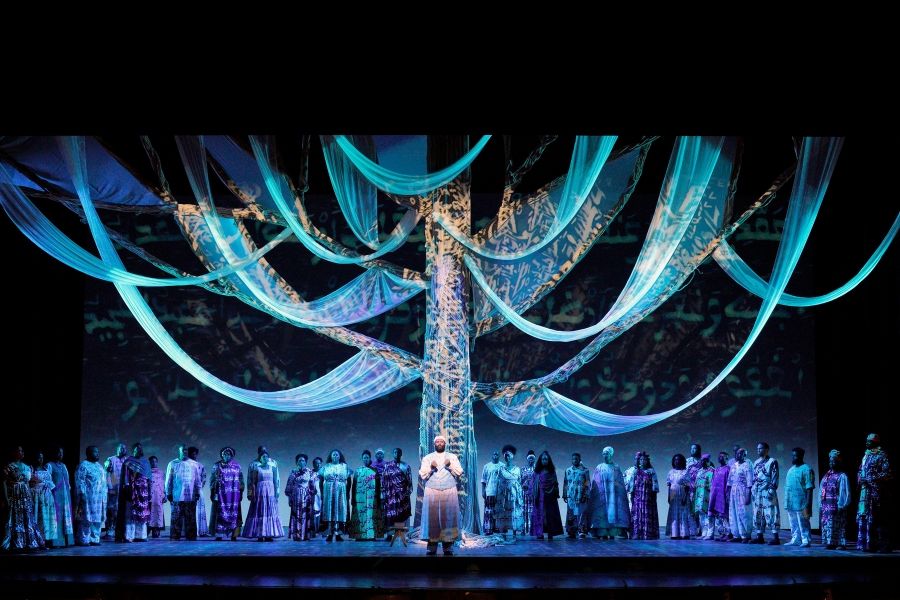
LA Opera's 2022 production of Rhiannon Giddens and Michael Abels's Omar.
A central dramatic tension in the opera is Omar’s relationship with Christianity, which he encounters through his enslavers. While historical accounts suggest that Omar outwardly converted to Christianity, the opera presents this transformation ambiguously, emphasizing his continued inner devotion to Islam. This duality becomes a powerful symbol of resistance and resilience. Supporting characters, including fellow enslaved individuals and slaveholders, provide a broader social context, illustrating the complexities of community, oppression, and survival.
The score of Omar incorporates elements of African music, spirituals, gospel, and Western classical traditions. Giddens’ influence is particularly evident in the use of traditional instruments such as the banjo, which has African origins but is often associated with American folk music. This choice underscores the continuity of African cultural heritage despite the rupture of slavery. Abels’ orchestration adds further depth, employing a full symphony orchestra alongside these vernacular elements. The integration of Arabic text and musical motifs evoke Omar’s Islamic faith and intellectual background.
Issachah Savage returns to Lyric in the title role of Omar alongside Kearstin Piper Brown as Julie and Lyric favorite Zoie Reams as Fatima. Conductor Kazem Abdullah, who led Lyric’s world premiere of Proximity, returns to the podium. Director Kaneza Schaal, who helmed the opera’s world premiere, creates a new theatrical presentation exclusively for Lyric. The work is both deeply personal and broadly resonant, inviting audiences to reconsider the narratives that shape American history and identity.