November 20, 2026
Celebrating Guys and Dolls, one of the greatestshows ever to dazzle Broadway
By Roger Pines
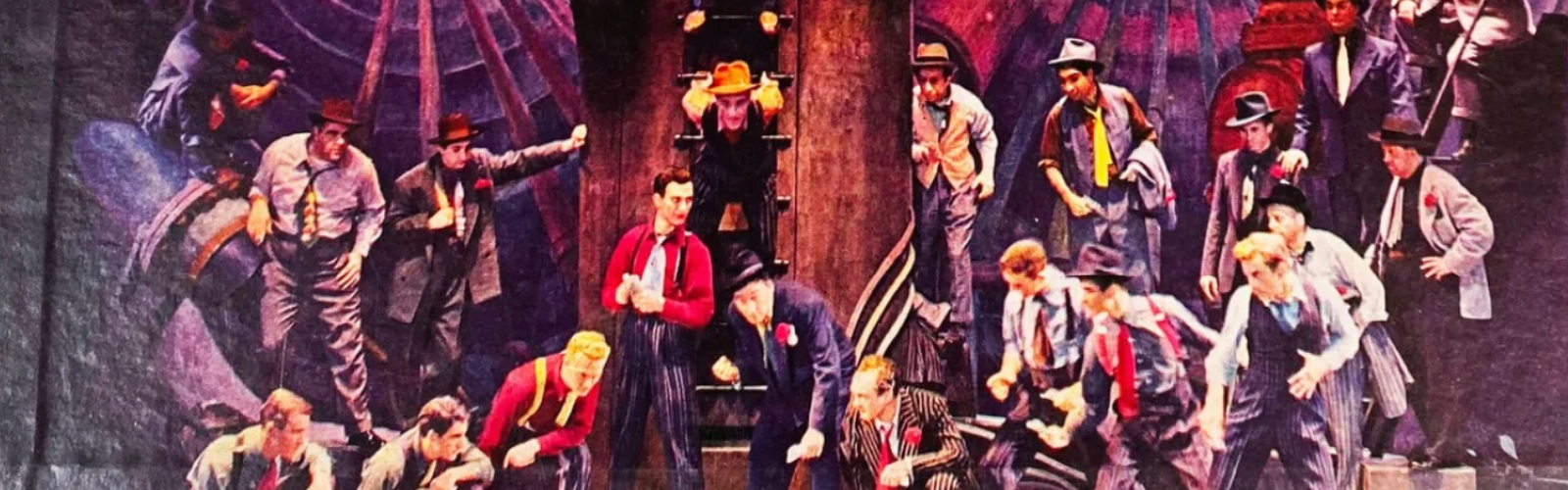
As the 1950s began, Broadway was in the middle of its “Golden Age.” So many great shows had happened in the past decade — shows that have stood the test of time. Their creators were all the legends, from Richard Rodgers and Oscar Hammerstein to Irving Berlin, Cole Porter, Alan Jay Lerner and Frederick Loewe, and more. But then, in 1950, came one of the greatest triumphs of them all, with one of the greatest names as its moving spirit — a composer-lyricist of fabulous wit and imagination. His name was Frank Loesser, and his show was Guys and Dolls.
Loesser and Abe Burrows (who created the dialogue) wrote a show that left its audience exhilarated. “Perfect” is a dangerous word to use in any of the performing arts, but if this show isn’t perfect, what show is? Everything works — every scene, every song, every character. But more important, there’s a whole world that springs to life in this show. It’s a world that totally connected with its New York audience 77 years ago, but — the test of any enduring stage work — it has reached across all boundaries and found a devoted audience all over the world.
Surprisingly, there’s really only one song from Guys and Dolls that has entered the so-called “American Songbook” of popular standards (“I’ve Never Been in Love Before,” one of the most captivating love songs ever written for Broadway). But what matters more is that every song in this score fits ideally into the show’s framework. In that respect, Loesser and Burrows were drawing on the most important development in that period of American musical theater: the firm integration of music with plot to create a marvelous seamlessness. When we experience Guys and Dolls in the theater, we stop noticing where song ends and dialogue begins, because they flow so remarkably into each other. This was the great step forward in the first shows of Rodgers and Hammerstein, Oklahoma! (1943) and Carousel (1945), which had a profound influence on every musical that followed for more than a quarter-century.
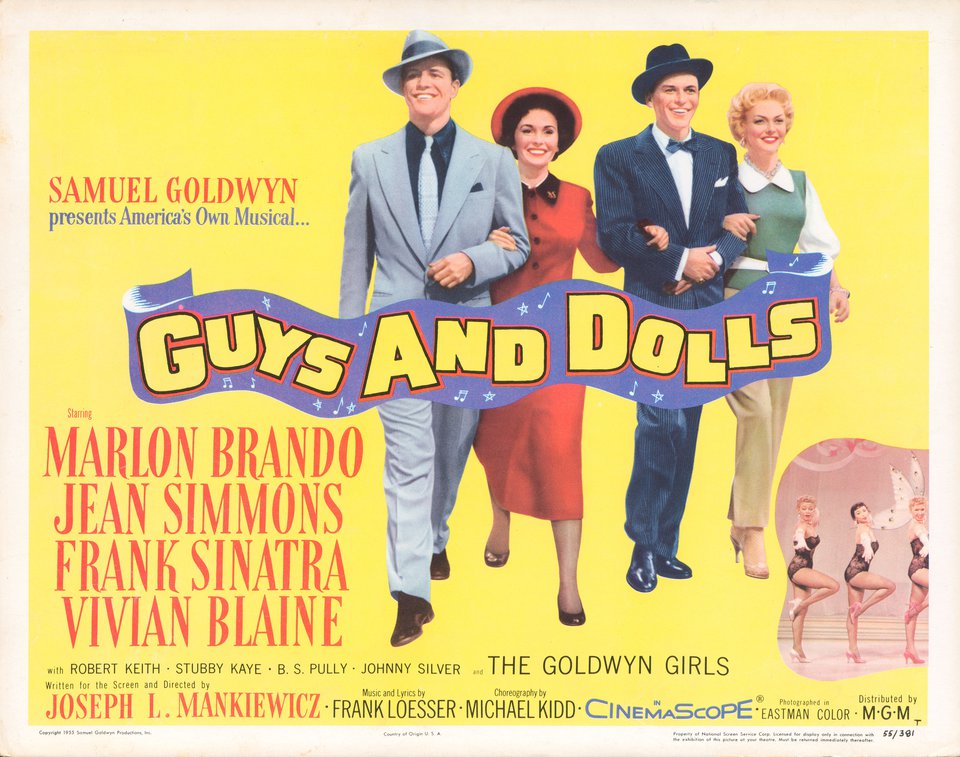
Guys and Dolls original 1955 promotional movie poster.
Guys and Dolls originated with three stories by a legendary figure of American reportage and popular literature, Damon Runyon (1880-1946). How unexpected that a guy who so perfectly wrote in the patois of New York City’s underworld of gangsters, showgirls, and local “characters” — where a woman was a “doll” and money was “dough” or “potatoes” — was actually born in Manhattan, Kansas! The son of a newspaperman, Runyon eventually entered the Army and covered the Spanish-American War. He then worked as a reporter and the manager of a semi-pro baseball team, before heading for The Big Apple, where he spent the rest of his life. He became one of the greatest journalists ever to cover baseball, but he’s better remembered today for his short stories, which he began writing in 1929. One of them, “The Idyll of Miss Sarah Brown,” was the main source for the Guys and Dolls plot, although Burrows also drew on elements of two other stories, entitled “Blood Pressure” and “The Winner.”
If you read Runyon, you’ll find a language that seems unique in all of New York-based literature. Having totally immersed himself in all things New York upon arrival, he knew whereof he spoke. He knew the denizens in neighborhoods that housed spots like the Hot Box Club and the Save-a-Soul Mission. He understood how everyone communicated, whether gangsters and gamblers or policemen. These weren’t the high-class types. Runyon’s people spoke almost exclusively in the present tense, and with an odd kind of dignity as the result of Runyon’s insistence on eliminating contractions. In “The Idyll of Sarah Brown,” one of the gamblers utters the following: “Why, in the first place I have no potatoes, and in the second place I doubt if it will do me much good if I do have any potatoes the way I am going the past year.” They bore unforgettable names, from Benny Southstreet to Harry the Horse, both of whom we meet in Guys and Dolls.
Two ambitious young producers, Cy Feuer and Ernest Martin, longed to see Loesser create a musical based on Runyon’s stories. The rights to this material were held by the Paramount film studio, but Loesser’s agents were able to connect the studio’s executives with Feuer and Martin and the producers got their wish.
It was Loesser and Burrows’ great achievement to musicalize Runyon’s world with as much authenticity as Lerner and Loewe would demonstrate six years later in transforming Shaw’s Pygmalion into My Fair Lady. The duo who wrote Guys and Dolls were both native New Yorkers who “got” Runyon’s style. Loesser was originally a “song plugger” on Tin Pan Alley who’d eventually established himself writing for Hollywood films, before returning to New York and a major success with his first important Broadway show, Where’s Charley? in 1948. Burrows, who’d met Loesser at a Beverly Hills party in 1943, had risen to prominence as head writer for one of radio’s most successful sitcoms, Duffy’s Tavern.
Burrows wasn’t the original writer for the Guys and Dolls libretto (a.k.a. “book”). That was Jo Swerling, a writer of many very successful screenplays. What Swerling produced, however, distressed Loesser, since it was distinctly unfunny. Loesser knew it couldn’t work, and that’s when Burrows came into the picture. The whole Swerling libretto was put aside; Burrows wrote an entirely new text, meshing everything with the songs that Loesser had already written, and with Loesser writing additional songs as the need arose. Despite none of Swerling’s work being used, by contract his name remained beside that of Burrows in the credits for the show.
Although Loesser was an opera fan, and a few operetta-like melodies figured in his effervescent score for Where’s Charley?. that wasn’t the feeling he wanted for Guys and Dolls (another Broadway masterpiece, Loesser’s The Most Happy Fella in 1956, would be as close as he got to composing in a virtually operatic style). With Guys and Dolls, he was writing entertainment pure and simple, depicting a sort of fairytale vision of New York (not for nothing was the show’s subtitle “A Musical Fable of Broadway”). The melodies were upbeat, but Loesser could also touch the heart with songs like “I’ll Know,” “I’ve Never Been in Love Before,” “More I Cannot Wish You,” and the unusually reflective and intimate “My Time of Day” (one of Loesser’s favorite songs in this score). He could also leave his audience in stitches with the hilariously adenoidal Miss Adelaide’s numbers, and with “Sit Down, You’re Rockin’ the Boat” he just plain raised the roof.
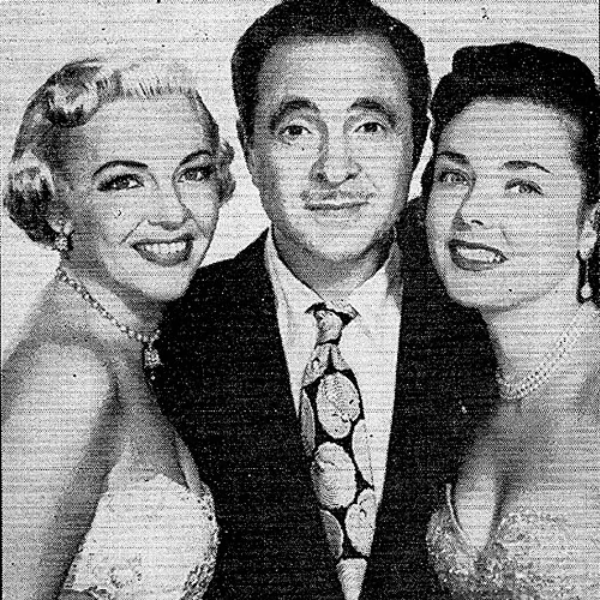
Vivian Blaine, Sam Levene, and Isabel Bigley in 1955 production of Guys and Dolls.
The original production of Guys and Dolls was blessed from the start, with a cast headed by debonair Robert Alda (Alan’s father) as Sky Masterson, paired with sweet-voiced Broadway ingenue Isabel Bigley as Sarah Brown; Sam Levene — a true “New York character” if ever there was one — played Nathan Detroit, opposite movie-musical star Vivian Blaine’s Miss Adelaide; and as Nicely-Nicely Johnson, making his Broadway debut, an ex-vaudevillian born Bernard Sholom Kotzin who was now known as Stubby Kaye. The director, George S. Kaufman, designers Jo Mielziner (sets) and Alvin Colt (costumes), and choreographer Michael Kidd were among the crème de la crème of New York theater, uniting with Burrows and Loesser to form a spectacular creative team. Kidd commented years later:
[The show was] by far the most complete, engrossing experience I have ever had in the theater…Many people have commented that it looked like one person had done the whole show. That’s because we were all of similar minds. We had similar backgrounds, and we all thought alike.
Opening in New York on November 24, 1950, the show was a rip-roaring success, one that would continue for 1,200 performances. Typical was the response of Richard Watts in the New York Post:
Guys and Dolls is just what it should be to celebrate the Runyon spirit, vigorous, noisy, humorous, tough on the surface and shamelessly sentimental underneath, filled with the salty characters and richly original language sacred to the memory of the Master, and a pleasure to all beholders. There can be no doubt that it is the town’s newest hit.
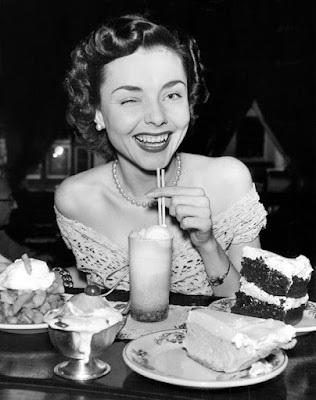
Isabel Bigley as Sarah Brown.
Guys and Dolls was seen by millions onscreen in one of the M-G-M studio’s most successful movie musicals, released in 1955. Except for the ever-lovable Vivian Blaine and irrepressible Stubby Kaye reprising their Broadway triumphs in this show, the casting of the principals was a surprise: Jean Simmons (Sarah) and Marlon Brando (Sky) because they weren’t singers, and Frank Sinatra (Nathan) because he was actually too much the singer in a role written for Sam Levene, who couldn’t sing! Brando and Simmons both handled their characters and music creditably. Sinatra, however, was awkward in the Runyonesque dialogue and Loesser — ordered by M-G-M to write additional songs for a “crooner” cast inappropriately — hated Sinatra’s vocal style in this role.
It seems incredible that no Broadway revival of Guys and Dolls was staged until 1976 when producers — no doubt remembering that an all-Black cast had brought a new excitement to the original Broadway production of Hello, Dolly! — tried the same thing with Guys and Dolls. Guided by Abe Burrows himself as production supervisor, that revival proved a great success. The show then went unseen on Broadway for quite a while, but meanwhile the British were entranced by it in a terrific 1982 production at London’s National Theatre that moved to the West End in 1984. Broadway finally got the message that it was time for another revival, which arrived in 1992. The gangbuster production earned four Tony Awards, among them Best Revival of a Musical and Best Actress in a Musical. The latter was Faith Prince, who stopped the show wailing “Adelaide’s Lament” and again when she squared off with Nathan Lane as that other Nathan, Mr. Detroit, in “Sue Me.”
The 1992 revival cemented a niche for Guys and Dolls as a summit of musical theater (many critics and audiences actually consider it the greatest American musical of them all.) As long as musicals are produced—whether on Broadway or in regional theaters, college and high-school drama departments, or community organizations — the show will continue to leave us captivated. It’s romance, it’s sidesplitting comedy, it’s sentimental and bawdy and thoughtful and exhilarating, all at the same time.
Roger Pines writes regularly for Opera magazine (U.K.), programs of America’s most distinguished opera companies, and major recording labels. A faculty member of Northwestern University’s Bienen School of Music, he has also been heard since 2006 as a panelist on the Metropolitan Opera broadcasts’ “Opera Quiz