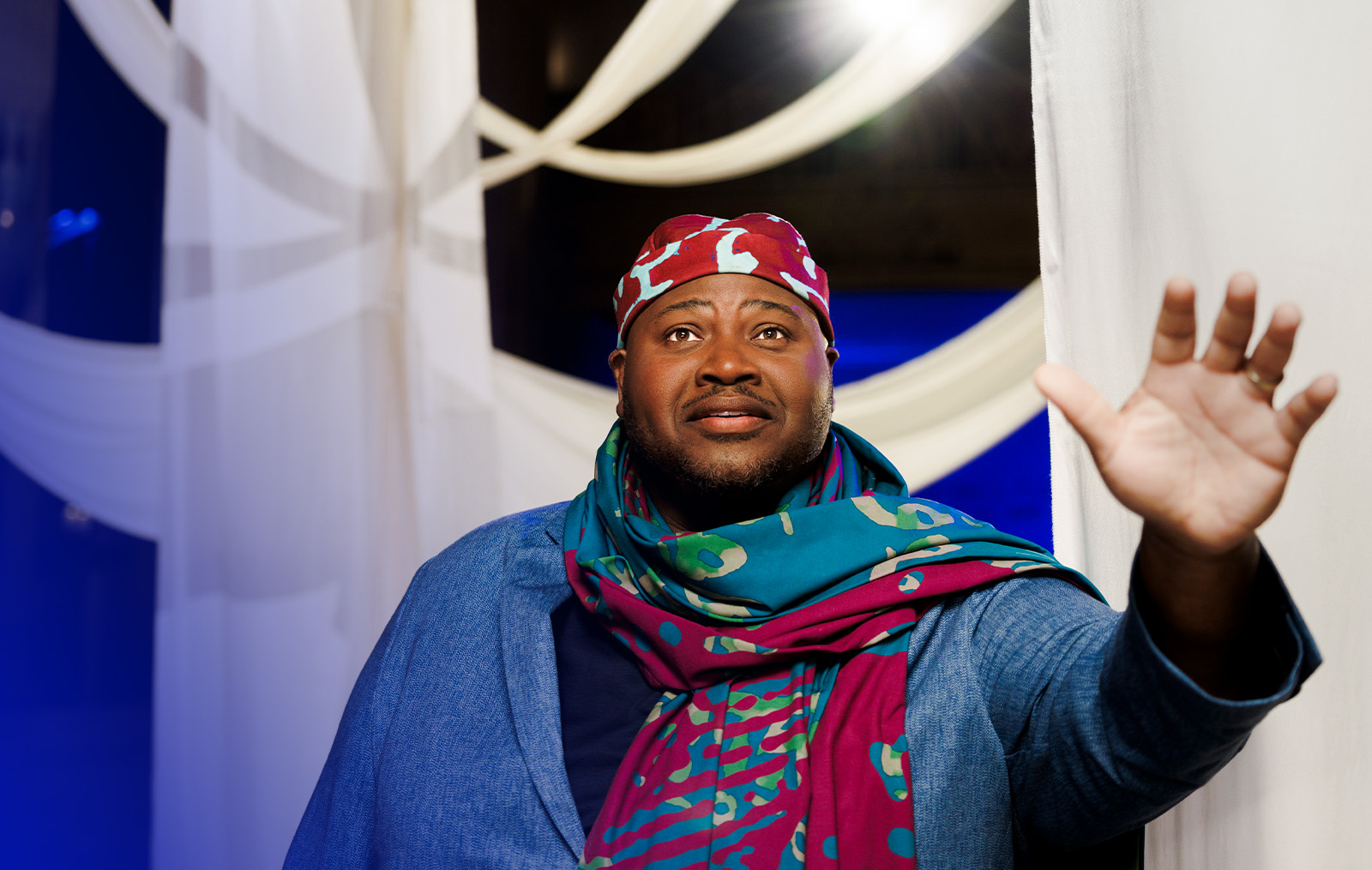
CHICAGO (9/10/2026) — Lyric Opera of Chicago presents the anticipated company premiere of Omar, the Pulitzer Prize–winning opera by Rhiannon Giddens and Michael Abels, on October 23, 25, and 28, 2026. A Lyric co-commission, Omar is inspired by the memoir of West African Islamic scholar Omar ibn Said — a Muslim whose writings preserve a firsthand account of the experiences of enslaved people in the New World — and tells a fundamentally American story of survival, faith, and identity. The score draws together hymns, spirituals, gospel, and bluegrass with African percussion instruments, setting the musical inheritance of the American South against the sounds of the West African homeland Omar was forced to leave behind.
Tenor Issachah Savage returns to Lyric in the title role alongside soprano Kearstin Piper Brown as Julie, Lyric favorite mezzo-soprano Zoie Reams as Fatima, and bass-baritone Kyle Ketelsen as the two Masters, Johnson and Owen. Mezzo-soprano Briana Hunter makes her Lyric debut as Katie Ellen and The Caller. The cast includes three members of Lyric’s renowned artist-development program, The Patrick G. and Shirley W. Ryan Opera Center: tenor Daniel Luis Espinal sings the Auctioneer and Taylor, mezzo-soprano Camille Robles is Eliza, and bass-baritone Matthew Dexter sings Abdul and Abe. Conductor Kazem Abdullah, who led Lyric’s world premiere of Proximity in the 2022/23 Season, returns to the podium to lead the Lyric Opera Orchestra. Director Kaneza Schaal, who helmed the opera’s world premiere, creates a new theatrical presentation exclusively for Lyric in her company debut.
As a co-commissioner of Omar, Lyric has been part of this landmark work’s journey from its very inception. The opera received its world premiere at the Spoleto Festival USA in Charleston, South Carolina in 2022 and won the 2023 Pulitzer Prize for Music. Its subsequent productions across the country have earned rapturous critical and audience response, and Chicago will be the latest American city to experience a work already establishing itself as a cornerstone of the American operatic canon.
Where memory is preserved, legacy endures. Omar ibn Said was born a free man in Futa Toro, in present-day Senegal, in 1770. An Islamic scholar and teacher fluent in Arabic, he was immersed in a life of intellectual and spiritual fulfillment. In 1807, he was captured and enslaved, transported across the Atlantic in the horrific conditions of the Middle Passage, and sold at auction in South Carolina. Despite losing everything — his homeland, his freedom, his family — he never lost his faith, his intellect, or his will to bear witness. In captivity, he wrote his autobiography in Arabic, the only known slave narrative written in that language. That document — his act of defiance, his prayer, his legacy — is the foundation on which Giddens and Abels have built their work.
The opera follows Omar from his peaceful village to the Charleston slave market to the plantations of North Carolina, where he encounters Julie, an enslaved woman who becomes his protector and friend; Fatima, the spirit of his mother who watches over him; and Katie Ellen and The Caller, figures who embody the communities around him. The white plantation owners attempt to erase his identity by forcing him to convert to Christianity — a conversion the opera treats with deep ambiguity, emphasizing his continued inner devotion to Islam as a powerful symbol of resistance and resilience. Omar’s faith, his literacy, and his determination to tell his own story prove inextinguishable. He writes. He remembers. He endures. And his words reach us still.
Faith, memory, and the music that survived the Middle Passage. At the heart of Omar is a collision of languages — spoken, sung, written, and musical — that mirrors the collision at the center of Omar’s life. Arabic text and musical motifs weave through the score, evoking his Islamic faith and scholarly background, while hymns, spirituals, gospel, and bluegrass rise up around them, gathered into a symphonic tapestry that honors them as what they are: American classical music, unapologetic and uncompromised. The orchestration is rich and distinctive, setting African percussion instruments — among them the kidi, the sogo, and the frame drum — alongside the standard symphony orchestra, conjuring a sound world at once ancient and urgently contemporary. Every tradition in the score carries roots in the culture Omar and those enslaved alongside him brought across the Atlantic — and refused to surrender. These are not borrowings. They are inheritances. In Omar, Giddens and Abels restore them to their rightful place in the American story.
Two artists, one American story. MacArthur Foundation "Genius Grant" recipient Rhiannon Giddens is one of the most celebrated and consequential musicians working in America today. A classically trained vocalist and multi-instrumentalist who co-founded the Grammy Award–winning Carolina Chocolate Drops, Giddens has built a career around a single, urgent mission: lifting up the people whose contributions to American musical history have been overlooked, and working toward a more accurate understanding of how this country sounds. She performs across folk, classical, opera, and ballet; returned to her home state of North Carolina to sing Bess in Greensboro Opera’s acclaimed production of the Gershwins’ Porgy and Bess; and hosts Aria Code, the popular podcast series co-produced by the Metropolitan Opera and WNYC, in which she explores the stories behind opera’s most celebrated arias. She serves as Artistic Director of Silkroad, where she is developing programs exploring the music of the builders of the American transcontinental railroad. She also served as a music consultant on Ryan Coogler’s 2025 Academy Award-winning film Sinners, contributing banjo to its soundtrack. She co-composed the music for Omar and wrote its libretto, drawn directly from the writings of Omar ibn Said. "I felt the connection to a time that I cannot easily imagine," Giddens has written. "I felt the spirits rise in me with every word written and every note composed." Her new album — Hope Is the Thing with Feathers — is set for release on September 18, 2026, through Nonesuch Records. It combines musical lineages from Louisiana, the Congo, Italy, and the Carolinas.
Two-time Emmy-nominated composer Michael Abels is best known to film audiences for his genre-defying, award-winning scores for Academy Award–winning director Jordan Peele’s films Get Out, Us, and NOPE — for which he received a World Soundtrack Award, a Jerry Goldsmith Award, and multiple critics’ awards. As a concert composer, his works have been performed by the Chicago Symphony Orchestra, the Philadelphia Orchestra, the Cleveland Orchestra, and many others; his orchestral work Global Warming has received more than 200 performances worldwide, and his More Seasons receives its Chicago Symphony Orchestra premiere in the 2026/27 Season. Several of his orchestral works have been recorded by the Chicago Sinfonietta on the Cedille Records label. A co-founder of the Composers Diversity Collective — dedicated to increasing the visibility of composers of color in film, gaming, and streaming media — Abels has long worked at the intersection of classical, folk, and popular traditions. Omar is his first opera. "I hope audience members are left in awe of the power of faith to transcend even the harshest circumstances," he has written.
A cast of celebrated artists, many returning to Lyric. Dramatic tenor Issachah Savage returns to Lyric in the title role, following his acclaimed Lyric debut as Curtis Toler in the world premiere of Daniel Bernard Roumain and Anna Deavere Smith’s The Walkers, part of the Proximity triptych in the 2022/23 Season. His recent triumphs include The Emperor in Richard Strauss’s Die Frau ohne Schatten at the Metropolitan Opera, Siegmund in Wagner’s Die Walküre with Canadian Opera Company, Radamès in Aida at Houston Grand Opera, and Bacchus in Richard Strauss’s Ariadne auf Naxos at Seattle Opera, in an extensive dramatic repertoire that has also brought him to LA Opera, Dutch National Opera, and the Salzburg Festival.
Soprano Kearstin Piper Brown returns to Lyric as Julie, having made her Lyric debut as Chief's Daughter #1 in the world premiere of Daniel Bernard Roumain and Anna Deavere Smith’s The Walkers, part of the Proximity triptych in the 2022/23 Season. She has performed at the Metropolitan Opera, Santa Fe Opera, and San Francisco Opera, and was honored with a Theatre World Award for Outstanding Debut Performance for her work in the leading role of Esther in Ricky Ian Gordon and Lynn Nottage’s Intimate Apparel at Lincoln Center Theater, a performance that was broadcast nationally on PBS’s Great Performances.
Mezzo-soprano Zoie Reams, a native of Chicago’s Hyde Park neighborhood, returns to Lyric as Fatima, the spirit of Omar’s mother. She was most recently seen at Lyric as Neris in the 2025/26 Season-opening production of Cherubini’s Medea and as a soloist in the sold-out world-premiere run of Billy Corgan’s A Night of Mellon Collie and Infinite Sadness. In the 2024/25 Season, she sang two roles at Lyric: the Mother in Jeanine Tesori and Tazewell Thompson’s Blue and Maddalena in Verdi’s Rigoletto. In the summer of 2026, she created the role of Zipporah in the world premiere of Kevin Day and Tifara Brown’s Lalovavi at Cincinnati Opera, part of its Black Opera Project, and she also tours the UK and Europe with Billy Corgan.
Bass-baritone Kyle Ketelsen returns to Lyric in the dual role of Johnson and Owen, Omar’s two enslavers. In Lyric’s 2026/27 Season-opening production of Mozart’s Don Giovanni, he sings the title role for the final two performances, October 30 and November 1. His most recent Lyric appearance was Howard in the company premiere of Missy Mazzoli and Royce Vavrek’s The Listeners in the 2024/25 Season. His 2025/26 Season included the title role in Don Giovanni at the Metropolitan Opera, Jochanaan in Richard Strauss’s Salome at the Hamburg State Opera, and Orest in that composer’s Elektra at San Francisco Opera.
Mezzo-soprano Briana Hunter makes her Lyric debut as Katie Ellen and The Caller, roles she has performed in Omar at LA Opera. A champion of new opera and the music of Black composers, Hunter created the role of the Mother in Jeanine Tesori and Tazewell Thompson’s Blue at the Glimmerglass Festival, a role she has since reprised to tremendous acclaim at Seattle Opera, Washington National Opera, and Pittsburgh Opera, and which was recorded for the Kennedy Center. She has appeared regularly at the Metropolitan Opera in operas including Terence Blanchard and Kasi Lemmons’s Fire Shut Up in My Bones, Bizet’s Carmen, Jake Heggie and Terrence McNally’s Dead Man Walking, and Puccini’s Madama Butterfly.
Tenor Daniel Luis Espinal, a current member of the Ryan Opera Center Ensemble, sings the roles of the Auctioneer and Taylor. He was a national winner of the 2024 Metropolitan Opera Laffont Competition, received a 2025 Sara Tucker Study Grant, and was in residence at the 2025 Aix-en-Provence Festival Académie and the Ravinia Festival’s Steans Institute. At Lyric, Espinal has appeared as Second Villager and a Young Man in Gabriela Lena Frank and Nilo Cruz’s El último sueño de Frida y Diego, Third Jew in Richard Strauss’s Salome, Beppe in Leoncavallo’s Pagliacci (in the 2025/26 Season), Don Curzio in Mozart’s The Marriage of Figaro, and as Jacquino in Beethoven’s Fidelio in his Lyric debut (in the 2024/25 Season). Later this season he will appear as an Officer in Richard Strauss’s Ariadne auf Naxos and as Giuseppe in Verdi’s La traviata. In the summer of 2026, he sang the role of Frederic in Gilbert & Sullivan’s The Pirates of Penzance at Opera Theatre of Saint Louis.
Mezzo-soprano Camille Robles, also a current member of the Ryan Opera Center Ensemble, sings the role of Eliza. Her roles at Lyric in the 2025/26 Season included Third Frida Image in Gabriela Lena Frank and Nilo Cruz’s El último sueño de Frida y Diego, Lola in Mascagni’s Cavalleria rusticana, and Second Handmaiden in Cherubini’s Medea for her Lyric debut. She has also performed in American Icons with The Joffrey Ballet. Later this season she will be seen at Lyric as Dryad in Richard Strauss’s Ariadne auf Naxos and Annina in Verdi’s La traviata. Robles received the American Opera Society of Chicago Award in 2026 and a Gulf Coast Region Encouragement Award in the Metropolitan Opera’s Laffont Competition in 2024.
Bass-baritone Matthew Dexter, also a member of the Ryan Opera Center Ensemble, makes his Lyric debut in the roles of Abdul and Abe. As a vocal fellow at Spoleto Festival USA, he appeared in the 2022 world premiere of Omar. Later this season at Lyric, he sings the role of Elder Ott in Carlisle Floyd’s Susannah. He recently earned his Master of Music degree in Early Music Voice from Yale University and the Yale Institute of Sacred Music. While at Yale, he sang on an international tour with Yale Schola Cantorum. Dexter was a 2025 Grant Park Music Festival Vocal Fellow and has toured twice as a soloist with Apollo’s Fire Baroque Orchestra.
A conductor devoted to the American operatic canon. Conductor Kazem Abdullah returns to Lyric to lead the Lyric Opera Orchestra in interpreting Giddens and Abels’s innovative score. He conducted the world premiere of Proximity in the 2022/23 Season — a triptych of contemporary works comprising The Walkers, composed by Daniel Bernard Roumain with libretto by Anna Deavere Smith; Four Portraits, composed and co-written by Caroline Shaw with librettist Jocelyn Clarke; and Night, composed by John Luther Adams with libretto by John Haines. One of the foremost champions of new American opera, Abdullah has been on the podium for some of the most significant American operas of the past decade, including Omar at LA Opera, Anthony Davis and Thulani Davis’s X: The Life and Times of Malcolm X at the Metropolitan Opera, and the world premiere of Gregory Spears and Tracy K. Smith’s Castor and Patience at Cincinnati Opera. Born in Indiana, Abdullah served as Music and Artistic Director of the City of Aachen, Germany from 2012 to 2017.
A director returning to Omar’s story. Director Kaneza Schaal makes her Lyric debut with a new theatrical presentation of Omar — one she first brought to life in the opera’s world premiere. A New York City-based artist working across theater, opera, and film, Schaal’s work has been presented at the Kennedy Center, the Whitney Museum, MoMA, the Holland Festival, the Walker Arts Center, and the Royal Lyceum Theatre Edinburgh, among many other leading venues worldwide. In her commitment to artist-centered institutions, Schaal co-founded the Gihanga Institute for Contemporary Art in Kigali, Rwanda. She serves on the board of directors of Under The Radar Festival in New York City. Her approach to Omar is rooted in the power of language — spoken, written, musical, and material — and in the extraordinary fact that Omar ibn Said’s words survive at all. "We gather to tell you Said’s story through the contest of languages in his life," Schaal has written. "Let us begin resetting the bones."
The artisans who bring Omar’s world to life. The visual world of Omar places Omar ibn Said’s own handwritten Arabic script at the center of every visual element, from the sweeping fabric backdrops — constructing cityscapes, plantation fields, jail cells, and a towering tree of life entirely from textile — to the costumes. Set designer Amy Rubin, costume designer Charlese Antoinette Jones, original co-costume designers Micheline Russell-Brown and April M. Hickman, lighting designer Pablo Santiago, and projection designer Josh Higgason complete the creative team, all in their Lyric debuts. Together they conjure a production in which language — spoken, sung, written, and woven in fabric — becomes the connective tissue of a world forcibly torn from its roots, and never fully destroyed.
A community bearing witness. The 60-strong Lyric Opera Chorus, prepared by Chorus Director Michael Black, is one of the emotional engines of Omar. The ensemble embodies the communities that surround Omar at every stage of his journey: the villagers of Futa Toro, the imprisoned souls of the Middle Passage, the enslaved workers of the Carolina plantations. At times the chorus sings only on open vowels, a wordless collective grief. At the opera's culminating moment, the entire company joins Omar in a great affirmation of faith and survival — a sound that stops audiences cold. Under Giddens and Abels's vision, the chorus is not just a backdrop. It is the American story itself, singing.
Continuing Lyric’s investment in the future of opera. With Omar, Lyric extends a commitment it has been building for years: expanding the operatic canon by commissioning, developing, and staging new American works that speak to this country’s past, its present, and the future it’s still writing.
In recent seasons, Lyric has accelerated that commitment through ambitious contemporary projects reflecting the company’s investment in new American voices, including safronia (2025/26), a five-year commission by the inaugural Chicago poet laureate avery r. young; Proximity (2022/23) — a trio of new works: The Walkers, composed by Daniel Bernard Roumain with libretto by Anna Deavere Smith, giving voice to families grappling with gun violence in Chicago; Four Portraits, composed by Caroline Shaw with libretto by Caroline Shaw and Jocelyn Clarke, examining disconnection in a world driven by technology; and Night, composed by John Luther Adams with libretto by John Haines, meditating on the fragility of the natural world; Will Liverman and DJ King Rico's The Factotum (2022/23), a reinvention of Rossini set on Chicago's South Side; and the site-specific Twilight: Gods (2020/21), a reimagining of Wagner’s Götterdämmerung that also featured young’s poetry. Each signaled a company willing to challenge assumptions about what opera is, who it serves, and whose stories command its grandest stages.
Omar joins that lineage as one of the most decorated new operas of its generation. A Lyric co-commission, it won the 2023 Pulitzer Prize for Music before making its way to Chicago — the long, deliberate process by which a new work moves from page to workshop to the stage. Omar arrives at Lyric at a moment when the stories it tells — of faith, of survival, of the stubborn, inextinguishable power of a single human voice — have never felt more urgent.
A voice suppressed, now soaring. Omar is an opera that dares to ask what it means to remember, to resist, and to write one’s own story when the world has conspired to silence you. It answers that question with some of the most original, emotionally shattering music written for the American operatic stage in a generation. The score weaves together the musical legacies of the African continent and the American South into something that feels at once ancient and completely alive — an inheritance, performed in person, for three performances only.
Lyric is honored to have been part of this journey from its beginning. That journey finally reaches Chicago this season, urgent and demanding to be witnessed — and then it moves on. For anyone who believes that opera can change the way we hear, think, and feel about the world we share, this is exactly what opera was built to do. This October, Chicago is where Omar sings.
Performance dates: Three chances to experience Omar:
- Friday, October 23, 2026 at 7:00 p.m.
- Sunday, October 25, 2026 at 2:00 p.m. — Touch tour at 12:00 noon. ASL interpretation, audio description, and SoundShirts.
- Wednesday, October 28, 2026 at 7:00 p.m.
Language: Sung in English with projected English titles.
Running time: 2 hours and 40 minutes, including one intermission.
Pre-performance talks: Ticketholders are invited to a free pre-opera talk by ethnomusicologist Adam Zanolini, Ph.D. on Omar’s history and cultural context; the talks begin one hour before each performance in the theater’s Steiner Parquet (the main floor).
Special events:
The Art of Culture – Presented October 10 – November 30, 2026 in Lyric’s Grand Foyer and Mezzanine, the exhibition will feature art from or influenced by West Africa in celebration of Lyric's performances of Omar. The art exhibition is free to all ticketholders.
Gen Z Round Table – Thursday, October 22; Reception at 6:00 p.m.; program 7:00 - 8:00 p.m. Wirtz Theatre inside Abbott Hall, part of the Virginia Wadsworth Wirtz Center for Performing and Media Arts on the downtown Chicago campus of Northwestern University, 710 N. Lake Shore Drive. Complimentary parking is available; the Abbott Hall parking lot is immediately adjacent to Abbott Hall, and is entered from Superior St. Note that Superior St. is one-way eastbound.
Artist Talkback — Join us immediately after the performance on Sunday, October 25, as Moderator Adam Zanolini, Ph.D. leads a discussion with the artists from Omar. Deepen your experience of this production by hearing how they brought this compelling story to life — and explore each artist’s personal connection to the opera.
Accessibility: The Sunday, October 25 matinee performance of Omar is presented with enhanced accessibility services, including:
- Touch tour at 12:00 noon — A guided pre-performance touch tour for patrons who are blind or have low vision, offering hands-on access to costumes, props, and the stage environment. No RSVP required.
- Live ASL interpretation — Real-time interpretation of the English-language opera into American Sign Language by two certified interpreters, with reserved seating for optimal sight lines.
- Audio description — Concise narration of scenes, settings, costumes, and action, delivered through headphones for patrons who are blind or have low vision.
- SoundShirts — Wearable technology that allows users to physically feel the music in real time, in sync with the orchestra and singers.
New Auracast assistive listening technology is available at all performances. Braille and large-print programs, high-powered opera glasses, assistive listening devices, and booster seats are available from the theater’s Steiner Parquet coat checks at all performances. For more information on these and other accessibility services, visit lyricopera.org/accessibility.
Commission and production history: Omar is co-commissioned by Lyric Opera of Chicago, Spoleto Festival USA, Carolina Performing Arts, San Francisco Opera, LA Opera, Boston Lyric Opera, and Detroit Opera. The opera received its world premiere at the Spoleto Festival USA in Charleston, South Carolina in 2022.
Location: Lyric Opera House, 20 N. Wacker Drive, Chicago, Illinois.
For more information and tickets, visit lyricopera.org/omar or call 312.827.5600.