January 15, 2026
Salome: desire and reckoning
Power and seductive charm, utterly without accountability: alarming to contemplate, horrifying to encounter. In Oscar Wilde’s novel The Picture of Dorian Gray (1890), an enchanting and glamorous youth has a piece of very good or very bad luck: his face and body show no trace of his vile, destructive, and selfish life, remaining beautiful and apparently kind — while his portrait, hidden away, tells the story of who he has really become, body and soul. (Eventually, confronting the portrait at last, he commits suicide by stabbing it in the heart.) This idea of a sensuality unfettered by accountability — and of an eventual reckoning – continued to fascinate Wilde, and in Salome (1892), he creates a female Dorian, her unchecked power over others through sensuous beauty and royal rank creating a total absence of moral concern. Because, unlike Dorian, she has no telling portrait, we (and the orchestra) must witness who she is for ourselves. Composer Richard Strauss uses Wilde’s play to create a terrifying opera, his searing and superbly crafted music imparting new depth to the play’s ideas.
The opera has always elicited passionate, and contradictory, reactions. Strauss’s conservative father disliked the fraught and nervous work, saying, “It is exactly as if one had one’s trousers full of maybugs.” By contrast, composer Gustav Mahler called it “one of the greatest masterpieces of our time.” The controversy continues. Musicologist Joseph Kerman, known for his pithy put-downs, called Salome’s final monologue (admired by most critics as the work’s finest passage) a “sugary orgasm.” But on the whole Mahler’s view has prevailed: it is among Strauss’s finest works, and it deserves its secure place in the repertory.
The opera’s basic story — Salome’s dance before Herod, his promise to give her whatever she asks for, her request for the head of John the Baptist on a platter, and Herod’s reluctant compliance — is already told in the Gospels by both Mark and Matthew. But there she is simply called the “daughter of Herodias”: the name Salome appears only in later sources. (Ironically, the name is related to Hebrew “shalom,” “peace.”) In the Gospels it is at her mother’s bidding that she makes her fatal request and to her mother that she delivers the grisly platter. She has no personal motives, so far as we are told.
Salome’s dance became famous in art and literature through the ages. Many later sources (including the 19th-century French writers Gustave Flaubert, Stéphane Mallarmé, and Joris-Karl Huysmans, all well-known to Wilde) focus on Salome’s seductive sensuality. The German poet Heinrich Heine suggested in 1843 that Salome developed a morbid fascination with the severed head, an idea that clearly influenced the playwright. In the 1870’s, the painter Gustave Moreau created a series of Salome paintings — including one of her dance and one called “The Apparition,” which, following Heine, depicts her fascination with the head. Both images are known to have obsessed the playwright, who reports that he kept dreaming about her. But the key idea that Salome’s request is motivated by frustrated desire and a thirst for revenge is Wilde’s original contribution, in pursuit of which he basically sidelines Herodias.
Wilde’s drama — written in the winter of 1891-92 in French for a London production starring the great actress Sarah Bernhardt — was ultimately refused production in London by the censors, since British norms forbade the representation on stage of Biblical characters. Bernhardt said she would try to arrange a production in Paris, but this never happened. The play was published in French in 1893 to great admiration, and in English a year later — in a translation made by Wilde’s lover, Lord Alfred Douglas, whose French was very bad. Wilde made some essential corrections, but did not begin from scratch, and the English version we have is unsatisfactory, full of awkwardness and archaic “thees” and “thous,” a sad contrast with Wilde’s graceful French. Someone should do a new one! Meanwhile, the play was eventually mounted in Paris in 1896, though not with Bernhardt.
By then, however, Wilde was in prison — sentenced to two years at hard labor for consensual sex acts with men (all in their twenties and treated by Wilde with courtesy and generosity). The trial judge, revealing British attitudes of the time, said: “It is the worst case I have ever tried.” Health broken, Wilde died in France in 1900. But while still in prison, he wrote one of his best works, in the form of a book-length letter to Douglas: De Profundis, a meditation on love, suffering, Christ’s life as paradigm, a person’s responsibility to cultivate his own soul — themes highly pertinent to his Salome, and to Strauss’s opera. Douglas the addressee, a beautiful young narcissist incapable of love and driven by vindictive fantasies (against his father), could be seen as a Salome prototype, though Wilde himself, loving and generous to the end, did not so see him.
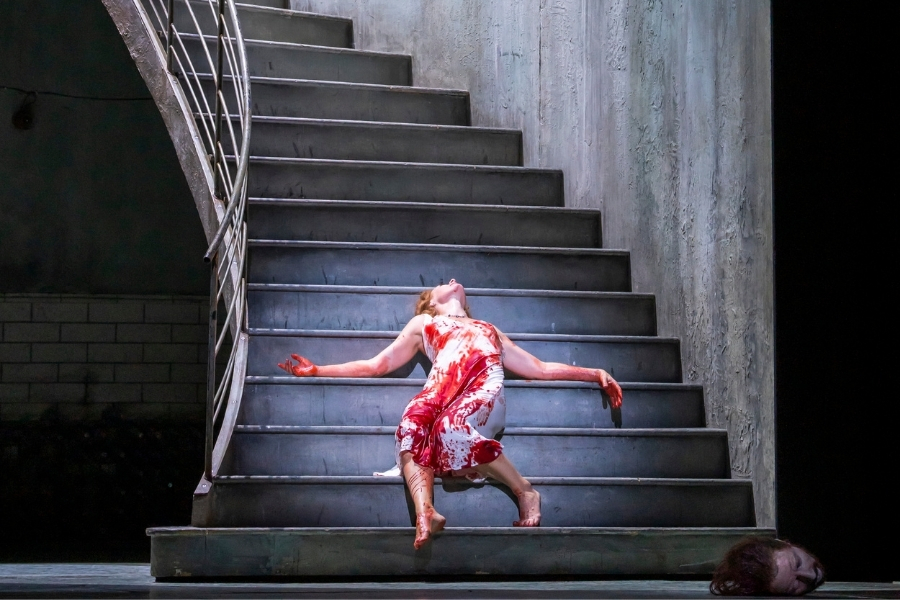
Salome meets her shocking, tragic ending, in a production at the Royal Ballet and Opera.
The play, meanwhile, had become a hit across Europe. A production at Max Reinhardt’s Kleines Theater in Berlin, in a translation by Hedwig Lachmann from Wilde’s French, was especially noteworthy. The German poet Anton Lindner had approached Strauss in 1902, proposing a verse libretto for an opera based on Wilde’s play, and he sent a few samples. But when Strauss saw the Reinhardt production, he decided to work directly from the German text of the play. He proved a wonderful librettist, judiciously cutting about one-third of the play’s dialogue, streamlining verbose language, eliminating several minor characters, and arranging the whole in the service of a tightly organized musical conception that goes beyond Wilde’s words in its emotional power. By 1905 the work had its premiere.
Salome is both an opera and a dramatic tone-poem. Its psychological and dramatic themes are advanced as much by the extraordinary orchestration as by the words that are sung. Strauss, as skillfully as Wagner before him, uses musical leitmotifs to trace the evolution of themes and characters, and his virtuosic use of individual instruments — perhaps especially woodwinds — gives them a key expressive role, from the opening clarinet glissando that introduces the princess to the end of the opera — including, along the way, the first known symphonic use of the “heckelphone,” an extended bass oboe with a wider bore, known for its penetrating sound.
Two aspects of Strauss’s musical realization have been panned by critics: the music for Salome’s dance, and the music written for Jochanaan (John the Baptist). The famous dance was probably written after the rest of the opera, since the version Strauss played for Mahler did not yet contain it (he said he would do it later). It is indeed, as critics say, little more than a pastiche of other parts of the opera, though it does achieve its dramatic purpose. But the attacks on Jochanaan’s music as banal and simplistic are, I believe, misguided, because Strauss made clear in letters that he fully intended to depict the prophet as an “imbecile,” “more or less a clown,” and for that reason gave him a “pedantic motif.” Beneath this creative decision lies the primary difference between Wilde and Strauss. Wilde was profoundly religious — not in the conventional high-church Victorian sense, but devoted to the personality and moral message of Christ, who, as he writes in De Profundis, “could bring peace to souls in anguish,” and cause those who had lived entirely for pleasure to hear “for the first time the voice of love.”
In Wilde, then, Salome’s tragedy is that she sees only her own desires and fails entirely to hear the prophet’s powerful message. Strauss, by contrast, had no use for religion, and in the opera he turns the prophet into a banal figure whom Salome’s narcissistic desires clothed in a beauty of her own invention. Critics may disagree with Strauss’s conception, but they should not say that he did not execute his purpose.
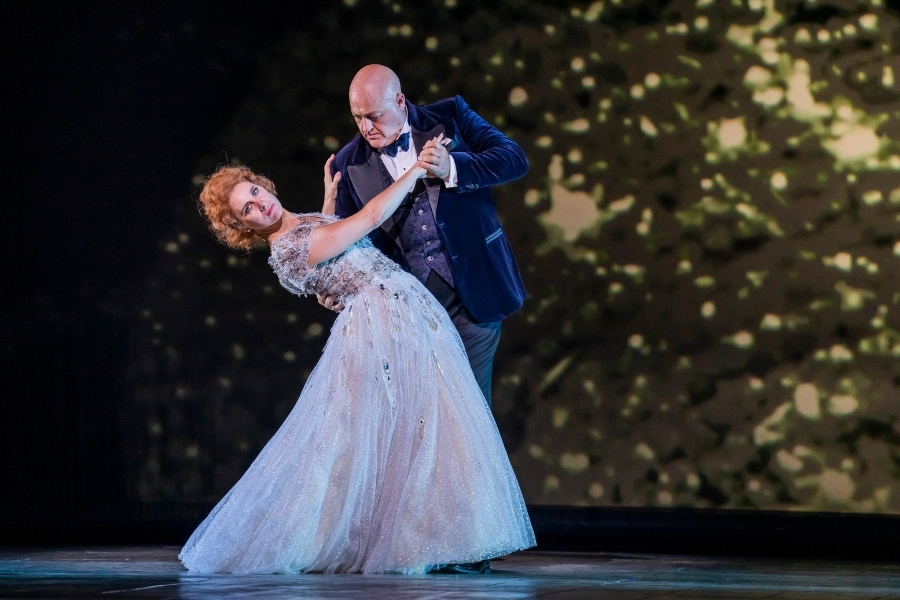
Salome and Herod share a toxic dance at the Royal Ballet and Opera.
But the heart of Strauss’s music-drama is the Princess, and here he achieves, all agree, a stunning success. Salome is a child who never became fully human — and this production, which shows her as very young, emphasizes this. All young children initially feel that they are the centers of the universe — what (Strauss’s contemporary) Freud called “infantile omnipotence.” But in a loving family they soon understand that their actions can hurt those who love and sustain them, and this crisis jolts them into recognition of the reality of others. Salome has two strikes against her: terrible parents — one utterly selfish, the other a would-be pedophile — and unlimited royal power. She therefore never undergoes any check to her omnipotence. She moves through the world arranging everything to accord with her desires, as we see early on from her manipulation of the charmed Narraboth, whom she destroys without even acknowledging his existence. A leading post-Freudian analyst, conversing with a narcissistic patient of this sort, speaks with him of a “struggle that never was,” the struggle that might have checked omnipotence and opened the door to concern and even love. Salome never encounters any such struggle, nor does she have any models of sanity and concern to steer her toward it. So she sees the world as a toy of her own mind, a mind at times delighted, at others petulant and vindictive.
Salome gets her wish, as usual. The head is delivered to her on a silver platter. She then launches into one of opera’s most remarkable and brilliant monologues — around seventeen minutes long — addressing the head with hair-trigger alternations between rapture and fury, tightly organized musically around a series of harmonic oppositions that signal the ambivalence of her passion. Salome never had a strong grip on outer reality, a world peopled by other human beings, but now she has retreated fully into her own mind, declaring her obsession with his mouth, his body, his hair, which she now triumphantly possesses. Repeatedly she berates Jochanaan for not returning her desirous gaze — as if he were alive — but she then announces her triumph over his resistance by proclaiming that she is alive and he is dead. She notices no contradiction.
She kisses the head with passion and then spirals into a demented declaration of her complete success. Forgetting that he never returned his gaze or listened to her, she is now utterly, serenely, delighted: She has kissed his mouth. The music, in the key of C sharp major, expresses the sweet climax of her passion. (This is what Kerman means by the “sugary orgasm” comment, wrong if used to put down Strauss, but accurate if it refers to Strauss’s insight into his character’s complete detachment from all awareness of her failure and of the hideous crime she has committed.)
But Strauss has a surprise in store. Two measures after the triumphant C-sharp major vocal line ends, we are assailed, in the orchestra, by a grotesquely dissonant chord, with no harmonic preparation or resolution — Newman calls it a “spasm” — that has riveted critics and audiences ever since, although quite a few pronounce it “sickening” and “disgusting.”
What does the shocking dissonance mean? In all the pages written about this chord, I find too little recognition that it is not, cannot be, inside Salome’s mind, depicting a sense of failure or self-awareness. She is too far lost in fantasy for that. Deliberately Strauss has positioned it after her happy triumph ends, as an external commentary on what we have just witnessed. Although nobody will have the last word about Strauss’s intriguing mystery, I propose that it is the opera’s analogue of the picture of Dorian Gray — the true portrait of the monstrous ugliness of Salome’s words and deeds. The reckoning that she horribly avoided has come at last, although she is utterly unable to grasp it. And sure enough: Herod now commands his soldiers, “Kill that woman.” And they do.
Martha C. Nussbaum is Ernst Freund Distinguished Service Professor of Law and Ethics at The University of Chicago. Her new book, The Republic of Love: Opera and Political Freedom, appears in April 2026