December 10, 2025
Both cynical and heartfelt: The enigma of Così fan tutte
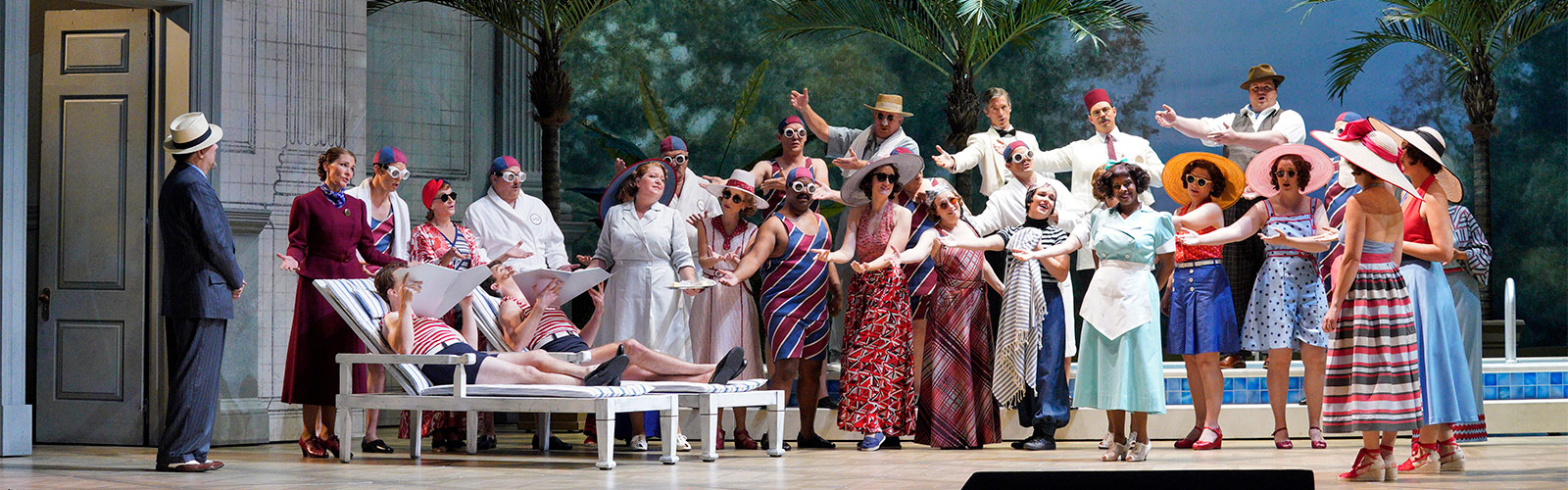
First performed on January 26, 1790, at the Burgtheater in Vienna, Così fan tutte, “Thus Do All Women” (subtitled “The School for Lovers”), was initially well received, but had only five performances during Mozart’s lifetime, on account of the death of the emperor Joseph II only a month later, and the ensuing mourning period. (Mozart would die less than two years later, on December 5, 1791.) During the nineteenth and early twentieth centuries the opera endured a long eclipse, being considered offensive and immoral. Sometimes, loving the music, people attempted to provide it with a totally different libretto: in one version, the replacement text was that of Shakespeare’s Love’s Labours Lost in French! Now, however, the opera is always in the top 20 of most-performed operas worldwide, ranking slightly below The Magic Flute, The Marriage of Figaro, and Don Giovanni. The beauty of its music has won the hearts of audiences.
Producers, critics, and audiences, however, continue to find Così a deeply problematic work. The great critic Joseph Kerman goes so far as to write, “Even the most devout Mozartian will have to admit that there is something unsatisfactory about Così” — which he calls “Mozart’s most problematic work.” What is the problem? In essence, it is a felt dissonance between the heartless spirit of Lorenzo Da Ponte’s libretto and the remarkable emotional expressivity of the music, especially in the second act. This dissonance is then rendered more problematic still by the cookie-cutter ending in which everything snaps back to the way it was before Act Two.
Da Ponte’s libretto is polished, well-constructed, witty — and cynical. Don Alfonso, the opera’s resident philosopher/observer/cynic, who creates the plan to test the fidelity of the young women, opines that emotions are short-lived and fickle, but the libretto ultimately goes yet further, suggesting that they are altogether unreal and factitious. Much of the work’s humor, in Act One, derives from the fact that while the women take their own emotions seriously, we are urged to see that they are only play-acting, imitating literary expressions of passion. (Singer-actresses have a challenge: while acting they must create the impression of mere play-acting, and later on show how different that is from genuine feeling.) Throughout Act One, Mozart’s music serves Da Ponte’s cynical purpose quite well, creating an artificial comedy with characters who are essentially cardboard cutouts and objects of knowing laughter (by Don Alfonso and Despina, and by us). We know very little about the nature of Mozart and Da Ponte’s collaboration, but we certainly have no evidence that, like Verdi, Mozart controlled the process and insisted on getting his way; the legendarily self-promoting Da Ponte’s letters suggest the opposite, rightly or wrongly.
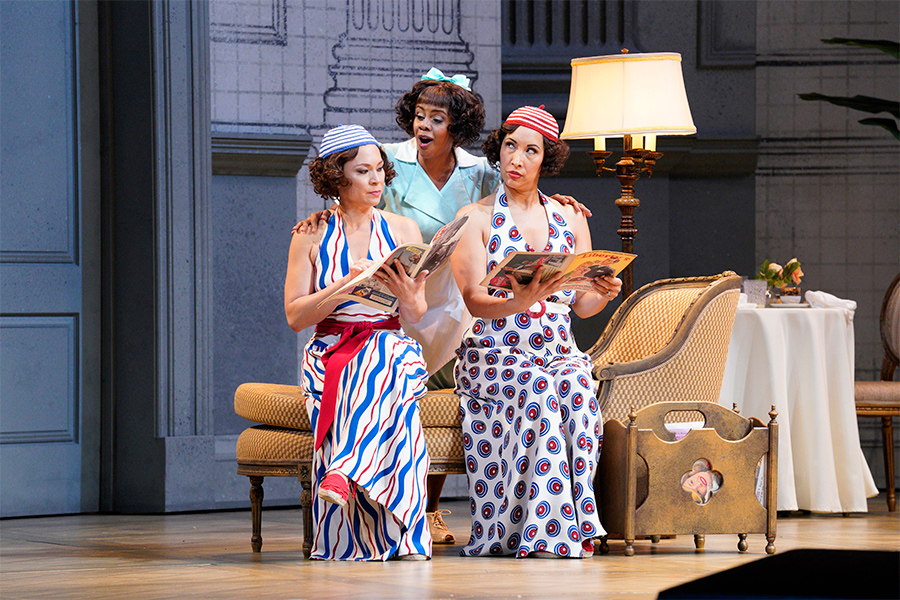
But Mozart cannot help taking emotions seriously, and by Act Two his genius for emotional insight, range, and particularity takes over, breaking the clever mold and subverting its purpose. In the other Da Ponte operas, it is also true that Mozart supplies emotional depth to texts that might have been set otherwise. (Just imagine, for example, in how many ways the text of Cherubino’s aria “Voi che sapete” in The Marriage of Figaro might have been set, and how completely it might have lacked the tender longing that it in fact expresses.) In Così, however, the music doesn’t just render emotionally determinate a text that is indeterminate; it actually subverts the entire point of the libretto. No, Don Alfonso, emotions are not just a game; they are real, and people have deep, interesting, and highly individual emotional lives.
In Act One, the girls are not very different from one another, and both play-act at emotions with a grandiosity that signals an absence of authentic self-knowledge and real erotic experience. In Act Two, both discover depths of emotional response in themselves — in highly particular ways. Both Kerman and philosopher Bernard Williams focus on the duet between Fiordiligi and Ferrando, “Fra gli amplessi,” (“In the embraces”), which shows Fiordiligi discovering love, and so discovering new capacities in herself. Emotions strike both lovers as mysterious, but also as totally real and urgent, as real as anything in the world can be. (And this is so, whether the emotions actually last or not: so long as they exist, they are both real and at the core of the person’s humanity.) The contrast between Fiordiligi’s Act One aria, where she is playing around with ideas of constancy like a would-be melodrama heroine, and this duet, with its soaring phrases and tremulous expression of passion, could not be more striking — and moving, too, as if we are seeing a mature woman being born.

Kerman seems to prefer the emotions of the serious pair to those of the comic pair simply because they are serious. Williams’s preference for the serious pair must be understood in connection with his often-expressed preference for Wagner’s Tristan und Isolde as the operatic paradigm of genuine love. (In introducing the posthumous collection in which his article on Così appears, Williams’s widow notes that he tested their budding relationship by taking her to a performance of Tristan, to see how much she loved it!)
But this is Mozart, the same Mozart who shows again and again that playfulness and humor can be a supreme expression of reciprocity in love. (And isn’t this an important truth in real life?) So I propose (contra Williams and Kerman, who are a bit contemptuous of the more light-hearted lovers) that we also do justice to the other pair. The moment in all opera that most unfailingly makes me weep for sheer joy at the precariousness and lovability of the world is Dorabella and Guglielmo’s Act Two duet, “ll core vi dono” (“I give you a heart”). The usual staging has him give her a heart-shaped locket as a token of love. She accepts it, and they then joke that the heart that was in one breast is now beating in the other’s: His heart (the locket) is now on her breast, and (she says) hers has now gone over there and is beating in his.
The music first expresses tender playful alternation, and then, with the delicate staccatos of the line “E batte così” (“And beats just so”), they are suddenly together. (That’s where I cry, invariably.) “O cambio felice,” “O happy exchange.” Dorabella has already said that she chooses Guglielmo because he seems more playful — and one is painfully aware that Ferrando, her original fiancé, was therefore utterly wrong for her (and right for Fiordiligi), since he is all lofty sentiment and no play. And now, with Guglielmo, she suddenly finds what she wanted all along: in the intimacy of joking and play she finds love’s reality, as the hearts change places and then somehow beat in harmony, though from the opposite place.
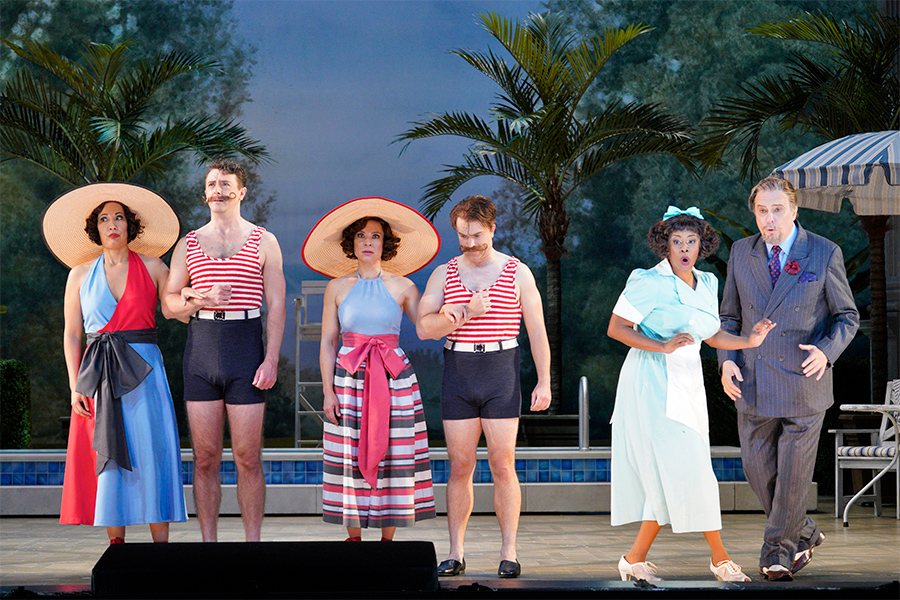
In effect, as Kerman wittily puts it, the second act belongs not to Don Alfonso but to “Don Wolfgango,” who, being himself, took emotion very seriously — including its soaring heights but including, as well, its capacity for tender play — and probed the characters’ depths with varied and aching effect. By offering the maid Despina no corresponding individuality in passion, Mozart seems to suggest that, in this world, emotional individuality requires leisure and may be incompatible with labor.
Act Two belongs to Mozart, but it must end as Da Ponte wrote it. Although the work has been staged in multiple ways, we are evidently supposed to think that the girls go back to their original partners. (Alfonso tells the lovers to marry the girls in spite of their fickleness, which implies that they take their original partners back. This is also the “lesson” intended from start to finish — in the libretto, that is.) According to the libretto, there is no loss, because all is convention and emotions are factitious anyway. But given the music of Act Two, the ending is deeply disturbing, and the message finally conveyed a veryrather? unpleasant one: As Williams puts it, what’s posited is “the idea that emotions are indeed deep, indeed based on reality, but the world will go on as though they were not, and the social order, which looks to things other than those emotional forces, will win out.” We might even see in the work a critique of the institution of marriage, as inimical to genuine love, at least for women.
Williams thinks that Mozart and Da Ponte collaboratively create this dark and disturbing insight. I find more persuasive Kerman’s suggestion that the libretto is one thing, the music in some respects quite another, and Mozart is trapped by the contrivance of the libretto, creating an ending that turns out jarring and unsatisfying.
And what of the war to which the men march off to cheerful choral song in praise of the military life? Is that part of the comic contrivance, or is it all too real? Might war not be another way in which the conventions of the world treat human emotions as if they do not matter? John Cox, director of Lyric’s 2017/18 production of Così fan tutte, wrote that as he sees it, the entire comedy “is played out on the edge of this abyss,” and that the unsettling darkness of the ending derives from this background reality. This suggestion (whether it’s about the libretto or the music, or both) dovetails with the ideas I have been exploring, though it also suggests a different orientation for our attention. Such layers show the work’s multivocal richness. And they surely do not negate the music’s astonishing capacity for the expression of love’s risks and delights.
Martha C. Nussbaum is Ernst Freund Distinguished Service Professor of Law and Ethics at The University of Chicago. Her new book, The Republic of Love: Opera and Political Freedom, appears in April 2026.