December 10, 2025
Back to nature: Renée Fleming returns
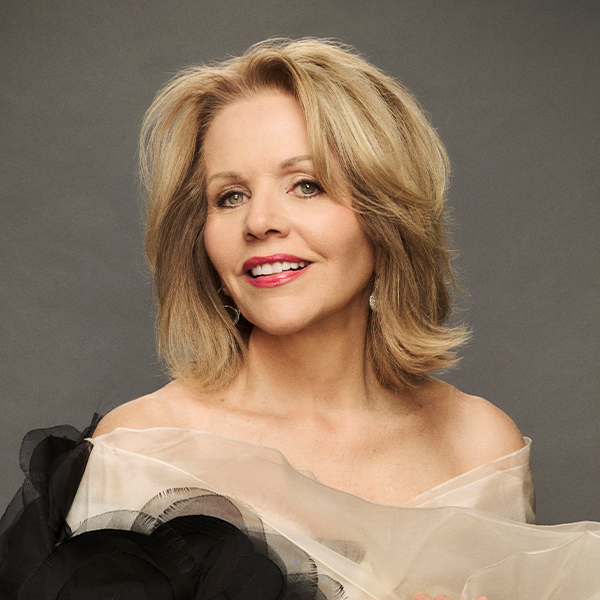
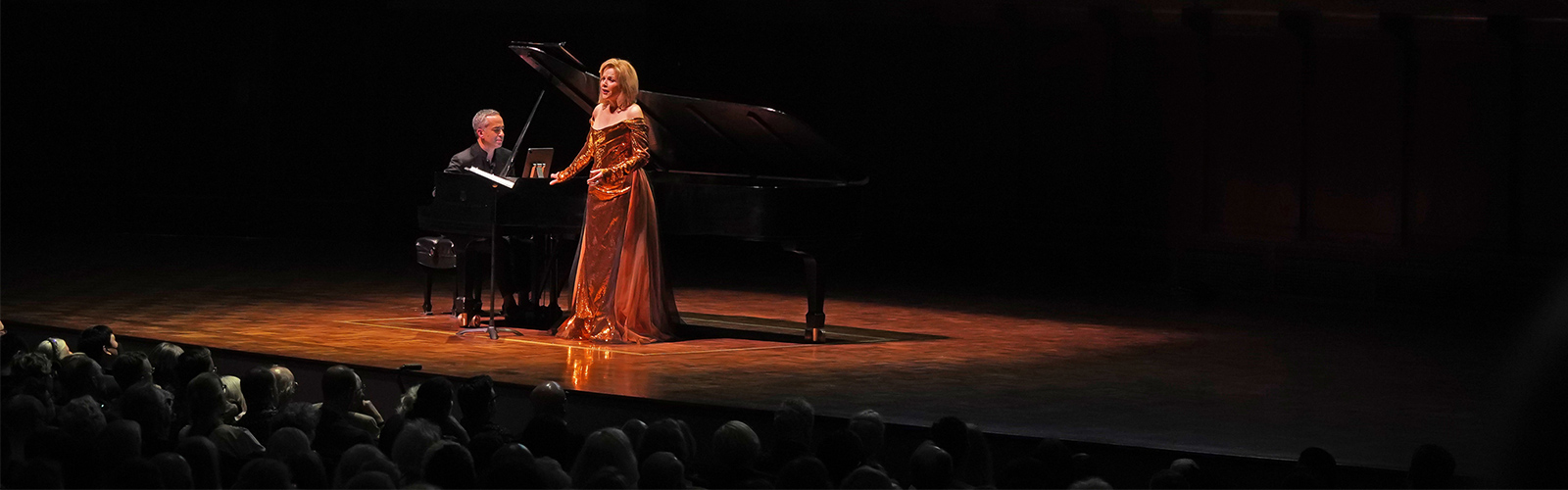
Every appearance by Renée Fleming at the Lyric Opera House is an occasion for rejoicing. It’s particularly momentous this season, as the internationally celebrated American soprano, a company favorite for more than three decades, has brought to Chicago “Voice of Nature: The Anthropocene,” one of the most fascinating projects of her entire career. It’s also her long-awaited first solo recital on the Lyric stage.
The meaning of “Anthropocene” is not entirely settled, but one online source defines it as “the current geological age, where human activities have become the main force shaping the Earth's environment, climate, and even its geological makeup.” In response to that all-encompassing reality, Fleming determined to focus this recital on nature, in all its beauty and mystery. The result is this captivating, deeply thoughtful program, previously presented with great success in numerous prestigious venues nationwide.
“When we were all cut off from our work. I’d recently moved to Virginia, right outside of D.C., and I fell in love with being outside — gardening, and taking walks in what is an extremely verdant area,” she says of how the recital was conceived. “I’d always thought about the fact that, historically speaking — at least, in my repertoire — the song literature I’d loved and performed really connected the poetry not only to every aspect of the human experience, but also through this lens of nature.”
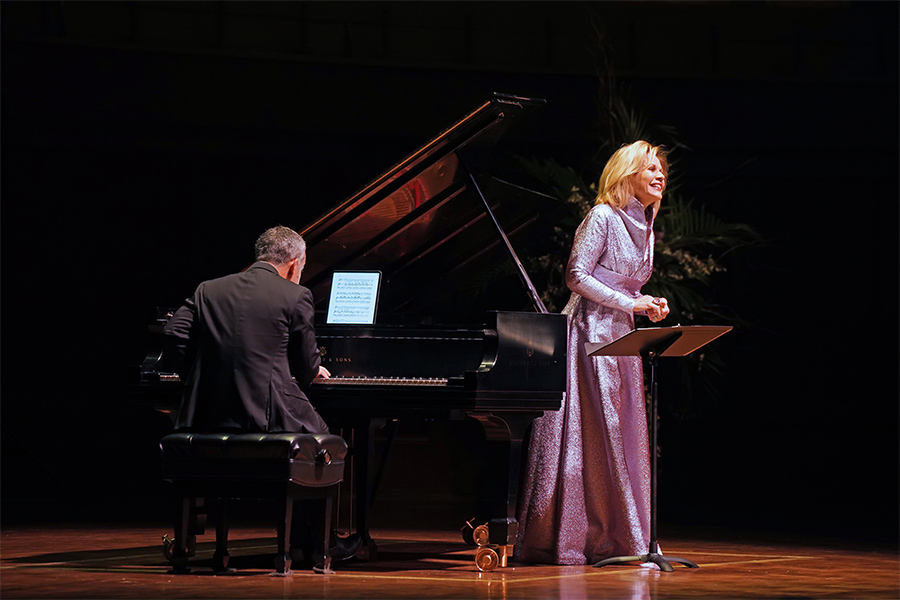
Renée Fleming in recital with pianist Inon Barnatan.
The recital itself grew from the success of “Voice of Nature,” the 2021 album Fleming recorded with Met music director Yannick Nézet-Séguin at the piano. The disc features a good deal of contemporary music, including several pieces commissioned by Fleming. Contemplating the environment, biodiversity, and sustainability confirmed the soprano’s realization that “we’re not so connected to nature now.” She kept those concerns foremost in her mind in the album. When it won a Grammy, she says, “I thought, I want to take this on the road — and I wanted to do it with media.” A random dinner party introduction lead to a meeting with the head of the National Geographic Society. “It was like a one-minute phone call,” Fleming remembers. “He said, ‘I definitely want to do this — we’ll make your films,’” and thus the path was clear for creating the program’s exciting visual component.
In short order Fleming was able to structure her recital, with every piece in the first half of the program having a clear connection to nature. The basic framework also had flexibility, allowing Fleming to switch out particular pieces easily whenever she felt a new addition was needed.
The opening song, Hazel Dickens’s “Pretty Bird,” is folk-like in character, and mesmerizing when sung a cappella. “People are surprised that I’m thinking and working in this style,” says Fleming. “But there’s something about folk music that has always touched me immediately.”
Another highlight of the recital will be one of Handel’s most breathtaking arias, “Care selve,” the only familiar music from his opera Atalanta. The composer “very often uses nature to help characters work through problems,” Fleming observes. “To me, it was completely logical to include it in this program.” The sheer loveliness of particular pieces is, not unexpectedly, an essential element of this recital; it plays a role not just with the Atalanta aria but also with “Bailero” from Canteloube’s Songs of the Auvergne. Fleming admits she’s performing the latter simply because “it’s just so beautiful! They’re talking to each other across canyons, but despite that distance there’s something charming about it at the same time.”
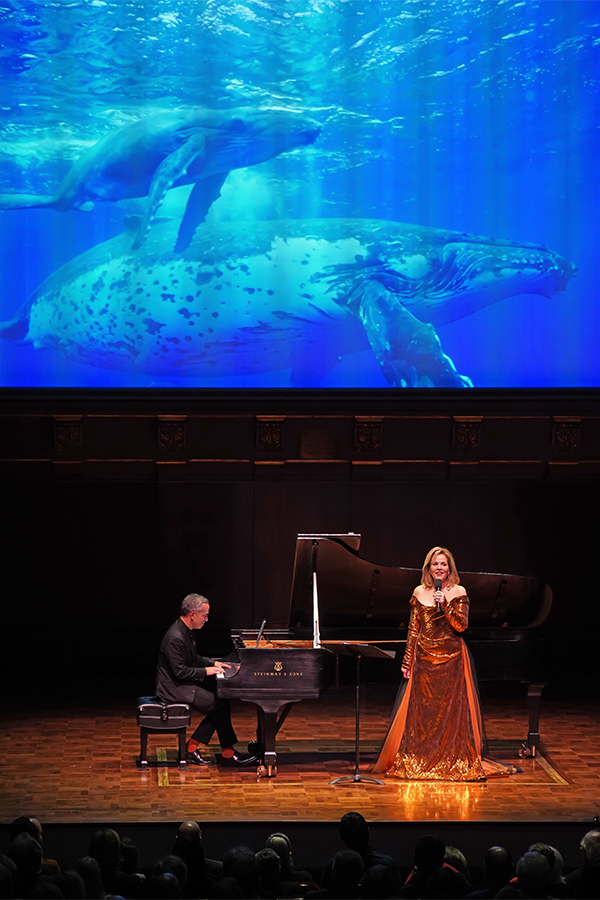
Voice of Nature: The Anthropocene features video curated by the National Geographic Society.
Among the commissioned pieces in the program is Nico Muhly’s “Endless Space,” which takes its texts from both 17th-century poet and theologian Thomas Traherne and a journalist writing in our own time, Robinson Meyer. Fleming has wide experience collaborating with living composers, a process with a strong collaborative element. “I’m always involved in thinking about the text, and certainly in creating and fashioning the theme,” she notes. “And of course, I always check that it’s vocally congenial for me. In this case it was easy — I love what Nico did!”
Another remarkable American composer, Maria Schneider, created the memorable song cycle, Winter Morning Walks, in 2013, to texts by former Pulitzer winner and U.S. Poet Laureate Ted Kooser. Fleming was entranced when she first heard the piece, in a Grammy winning recording by Dawn Upshaw. “I’ve sung the whole cycle,” Fleming says. “It’s actually very hard for me to find up-tempo numbers, because my voice and my sensibility want to languish. This was an attempt to break up the languor!” From Schneider’s cycle, Fleming has chosen “Our Finch Feeder,” the text of which includes some notably striking imagery — for example, the finch feeder being “oily and dark as ammunition.”
The biggest surprise for the audience will surely be Björk’s “As Is Full of Love,” a song that is “really about the earth,” says Fleming. It impressed her that the Icelandic singer-songwriter was influenced by world-renowned naturalist David Attenborough (at the time of Björk’s 2011 album “Biophilia,” Attenborough met with her to discuss the nature of music and the intersection between music, nature, and technology). “Björk is a soprano,” Fleming adds, “so that helped a lot. I did a set of three songs of hers with a fantastic orchestrator, Hans Ek, and recorded them with the Stockholm Philharmonic a long time ago. They just really worked. I remember that I sang [another song from the cycle] ‘Virus’ with the New York Philharmonic on the eve of the announcement about Covid, which was a little unfortunate!”
Not all the music to be heard by the Lyric audience comes from the “Voice of Nature” album — the soprano has chosen to include certain pieces she’s rarely performed before. Recalling Fleming’s contribution to the soundtrack of one of the most successful fantasy films ever made, Fleming’s daughter told her, “‘Lord of the Rings is our touchstone — why don’t you ever perform it?’” I thought it would be perfect.”
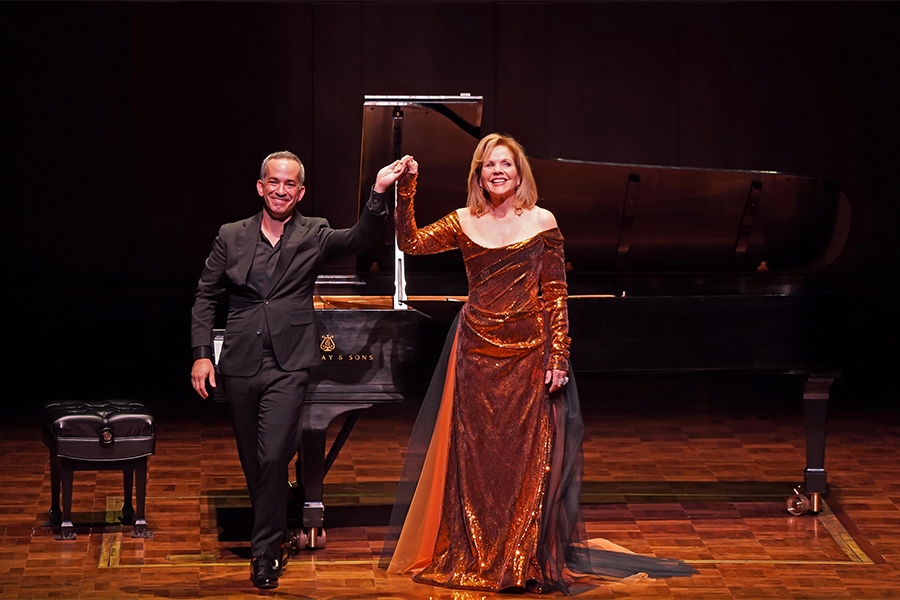
Voice of Nature collaborators Renée Fleming and pianist Inon Barnatan take a bow.
For the “Voice of Nature” recitals, the exceptionally gifted American/Israeli Inon Barnatan has been Fleming’s onstage collaborator. “He’s an exquisite pianist,” Fleming says simply. “It’s a luxury to sing with him.” Neither of them are daunted by the prospect of performing in the expansive Ardis Krainik Theatre.
Fleming scored a great success at Lyric in 2013, singing an elegant, all-French duo recital with Susan Graham. “It’s not so intimate that you can whisper,” she notes, “but beyond that it’s no different. You always have to project!”
Wherever “Voice of Nature: The Anthropocene” has been presented, the second half of the program has tended to be on the lighter side. After the first half, “as much as the audience can sit there and think this music is incredibly beautiful, it’s clear that humans are not being very good to the earth right now — you can see that on people’s faces. So it’s great if at the end they can leave humming, singing, and ultimately uplifted.”
Roger Pines writes regularly for Opera magazine (U.K.), programs of America’s most distinguished opera companies, and major recording labels. A faculty member at Northwestern University’s Bienen School of Music, since 2006 he has been a regular panelist on the Metropolitan Opera broadcasts’ “Opera Quiz.”